Not long ago, a buyer looking for “the best agency for X” would open Google and scroll through ten blue links. Today, many of them type the same question into ChatGPT, Perplexity, or Google’s AI Mode and get one confident, summarized answer with a handful of brand names in it. If your brand is in that answer, you get the trust and the click. If it isn’t, you’re invisible at the moment of decision. That is the problem Generative Engine Optimization (GEO) solves.
This guide explains what GEO is, how AI engines choose which brands to recommend, and the exact steps to get your brand mentioned and cited.
What Is Generative Engine Optimization?
Generative Engine Optimization is the practice of structuring your content, brand signals, and website so that AI-powered engines like ChatGPT, Perplexity, Gemini, and Google AI Overviews can understand, trust, and cite you in their generated answers.
Traditional SEO aims to put your page in a ranked list. GEO aims to make your brand part of the answer itself. Moving from SEO to GEO (Start the shift) doesn’t mean abandoning what you know. It means extending it for a world where answers are generated, not listed.
One clarification matters here. ChatGPT doesn’t rank brands the way Google ranks pages. It mentions, recommends, and cites them. “Ranking on ChatGPT” really means earning a place in the sources and brands the model chooses to surface. That’s the goal throughout this guide.
GEO vs SEO: What’s the Difference?
GEO and SEO share the same foundation, but they differ in what they optimize for. SEO is built to earn a high position on a results page, while GEO is built to earn a mention inside an AI-generated answer. Knowing where the two overlap and where they split helps you invest in both without wasting effort.
- Goal: SEO wants a high position on a results page. GEO wants a mention or citation inside an AI-generated answer.
- Output: SEO delivers a list of links. GEO delivers a synthesized paragraph, often with a few named sources.
- Signals: SEO leans on keywords, backlinks, and page experience. GEO leans on clarity, authority, consistency, and third-party validation.
- Metrics: SEO tracks rankings and clicks. GEO tracks brand mentions, citations, and AI referral traffic.
GEO does not replace SEO. AI engines still rely heavily on content that search engines have already crawled, indexed, and trusted. If you want to see how those underlying signals work, it helps to understand how Google ranks (Know the signals) websites today, because the same quality signals feed AI answers.
Why GEO Matters for Your Brand in 2026
Search behavior is changing fast, and the change is visible in three ways.
- Zero-click answers are growing. Users get what they need from the AI summary and never visit a site.
- Conversations replace keywords. People ask long, specific questions like “Which agency is best for a small healthcare website in India?” instead of typing two-word queries.
- Brand mentions are the new visibility. Being named in an answer carries the weight of a recommendation.
Brands that build AI visibility now will be the default recommendations later. Your presence across platforms also feeds this, since AI engines learn what a brand is known for from many places, including the conversations happening around social media trends (Turn buzz into leads) and audience engagement.
How ChatGPT Decides Which Brands to Recommend
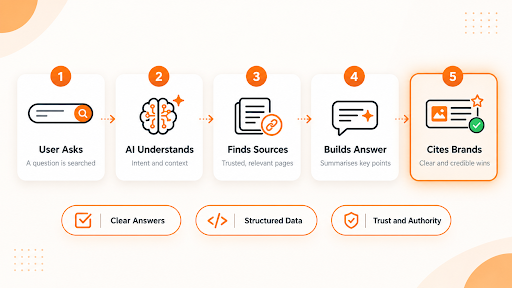
ChatGPT builds answers from two sources: patterns learned during training, and live web retrieval when search is enabled. Both reward the same things.
- Authority and consistency. Brands described the same way across many trusted sources are easier for a model to recognize and repeat.
- Third-party mentions. Reviews, directories, news coverage, and community discussions act as independent proof.
- Structured, quotable content. Clear definitions, direct answers, and well-organized pages are easier to extract.
- Trust in sensitive topics. For high-stakes industries, models are more cautious and favor sources with visible expertise. A good example is healthcare SEO (Check the real cost), where credentials, accuracy, and transparency matter even more.
In short, AI engines recommend brands they can verify. The more clearly and consistently your expertise appears across the web, the more confidently a model can name you.
How AI Overview Optimization Actually Works
Google’s AI Overviews work differently from ChatGPT in one important way: they sit on top of Google’s own index. That means your path to appearing in them runs through traditional search quality first.
Here is how the process generally works:
- Query understanding. Google interprets the question, often breaking a complex query into several smaller sub-questions.
- Retrieval. It pulls relevant pages from its index, favoring content that directly addresses each sub-question.
- Synthesis. The AI combines the most useful passages into a short answer.
- Attribution. It links to the sources it drew from, usually a small set of pages.
Because of this, optimizing for AI Overviews means optimizing at the passage level, not just the page level. Each section of your content should be able to stand alone as a clear, correct answer.
Practical steps that help:
- Open each section with a direct, one- or two-sentence answer before adding detail.
- Use clear headings that mirror the way people phrase questions.
- Support claims with specifics, examples, and named sources.
- Add structured data so Google can interpret your content accurately.
None of this works without a healthy site underneath. Understanding technical vs on-page SEO (Fix your base) helps you see which layer is holding you back, since a page that can’t be crawled or doesn’t match search intent will never be pulled into an AI Overview.
Answer Engine Optimization and Its Overlap With GEO
You will often see Answer Engine Optimization (AEO) mentioned alongside GEO. The two terms are closely related, and the line between them is thin.
AEO focuses on optimizing content to be chosen as the direct answer, whether in a featured snippet, a voice assistant response, or an AI-generated summary. GEO is broader. It covers how generative AI models understand, represent, and recommend your brand overall.
Where they overlap:
- Both reward concise, accurate, answer-first writing.
- Both depend on clear structure, such as question-based headings, short paragraphs, and lists.
- Both benefit from schema markup, especially FAQ and Article schema.
- Both rely on strong EEAT signals to decide who is trustworthy.
Where they differ:
- AEO is mostly about winning a specific answer for a specific question.
- GEO is about building lasting brand presence across many AI platforms and prompts.
In practice, you don’t need two separate strategies. Content built to answer questions precisely is the engine behind both. If your pages aren’t earning visibility because the content itself is thin or unfocused, investing in content development (Fix weak content) is usually the fastest place to start.
8 Proven GEO Strategies to Rank Your Brand on ChatGPT
AI engines don’t pick brands at random. They recommend the ones they can understand, verify, and trust across the web. The eight strategies below cover all three: how you write, how you build credibility, and how you structure your site. Apply them together and your brand is far more likely to be mentioned and cited in AI-generated answers.
- Write answer-first content. Lead each section with a direct answer, then expand. This makes your text easy to quote.
- Strengthen EEAT signals. Add author bios, credentials, case studies, and real client outcomes so both readers and models can verify your expertise.
- Build third-party mentions. Earn presence on review sites, industry directories, PR coverage, Reddit, and Quora. AI engines treat outside validation as proof.
- Add schema markup. Use Organization, Article, and FAQ schema to label your content clearly.
- Keep your brand information consistent. Your name, services, and descriptions should match everywhere they appear.
- Publish original insights. Original data, expert opinions, and first-hand experience give models something unique to cite.
- Target conversational queries. Write for the long, natural questions people ask AI tools, not just short keywords.
- Refresh content regularly. Updated pages signal reliability, especially on fast-moving topics like GEO.
Strong fundamentals tie all eight together. Working with a team that offers SEO services (Explore SEO help) can speed up the process, because GEO builds directly on solid search optimization.
Technical GEO Checklist
Even the best content won’t get cited if AI engines can’t reach it or make sense of it. Technical GEO makes sure your site is open, fast, and easy for machines to read. Run through this checklist to remove the barriers that quietly keep your brand out of AI answers.
- Allow crawlers. Check that your robots.txt doesn’t block AI and search bots you want visibility from.
- Improve site speed. Slow pages are harder to crawl and frustrating to users.
- Use clean heading structure. One H1, logical H2s and H3s, and descriptive titles.
- Make content readable in HTML. Don’t hide key information inside images or heavy scripts.
- Secure the site. Use HTTPS and keep the site stable.
- Build logical internal linking. It helps engines understand how your topics connect.
A fast, clean, well-structured website is the base layer for everything else, which is why website development (Build it right) quality directly affects how easily AI systems can read your brand.
How to Track Your Brand’s Visibility in ChatGPT
GEO results don’t appear in a traditional rank tracker, so you need a different approach.
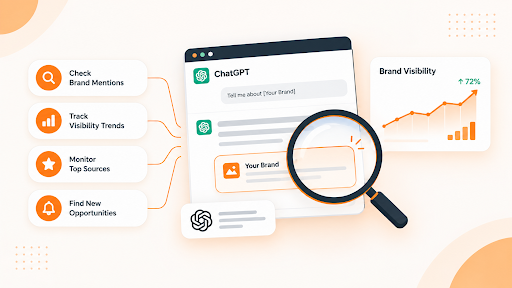
- Test prompts manually. Ask ChatGPT, Perplexity, and Gemini the questions your customers ask, and note whether your brand appears.
- Track AI referral traffic. In GA4, look for visits from chatgpt.com, perplexity.ai, and similar sources.
- Monitor brand mentions. Use mention-tracking tools to see where and how your brand is discussed.
- Record changes over time. Repeat the same prompts monthly, since AI answers shift.
Treat this as a trend line, not a single score. Answers vary between sessions, so patterns matter more than any one result.
Common GEO Mistakes to Avoid
Many brands lose AI visibility because of avoidable errors.
- Keyword stuffing. AI models read for meaning, not repetition.
- Publishing thin, generic AI-written content. If it adds nothing new, there’s no reason to cite it.
- Ignoring off-site presence. Your own website is not enough. Models weigh what others say about you.
- Skipping trust signals. Pages with no author, no sources, and no proof are easy to pass over.
- Weak brand clarity. A confusing or forgettable identity makes you harder to recall. Even naming choices play a role, as shown in the debate around a long domain name (Keep it simple) versus a short one.
How UPBS Technology Helps Brands Win in AI Search
At UPBS Technology, we combine SEO, content strategy, web development, and paid ads to help brands stay visible wherever their customers search, from Google to ChatGPT and Perplexity.
Our approach to GEO includes:
- Auditing your current AI visibility and search foundation
- Creating answer-first, EEAT-compliant content
- Strengthening technical SEO and schema
- Building brand mentions and authority across trusted platforms
If you want your brand to be the one AI recommends, our team can build the roadmap with you.
Conclusion
Search is no longer only about ranking pages. It’s about being the brand an AI trusts enough to recommend. Generative Engine Optimization gives you a clear path there: write answer-first content, build real authority, keep your brand consistent, and make your site easy for machines to read. Start with the fundamentals, apply the eight strategies above, and track your visibility over time. The brands that act now will be the ones AI keeps recommending tomorrow.
Ready to get your brand cited by AI? Contact UPBS Technology and let’s build your GEO strategy.
FAQs
What is Generative Engine Optimization (GEO)?
GEO is the practice of optimizing your content, website, and brand signals so AI engines like ChatGPT, Perplexity, and Google AI Overviews can understand, trust, and cite you in their generated answers.
Can you actually rank on ChatGPT?
Not in the traditional sense. ChatGPT doesn’t show a ranked list of pages. It mentions and recommends brands, so the goal is to earn those mentions and citations through authority, clarity, and third-party validation.
Is GEO replacing SEO?
No. GEO builds on SEO. AI engines still lean on content that search engines have already crawled, indexed, and trusted, so strong SEO fundamentals remain the foundation.
How does AI Overview optimization work?
Google’s AI Overviews break a query into sub-questions, pull relevant passages from its index, and combine them into a short answer with source links. To appear in them, write answer-first sections, use question-style headings, and make sure your site is crawlable and indexed.
What is Answer Engine Optimization (AEO)?
AEO is optimizing content to be chosen as the direct answer to a specific question, whether in a featured snippet, a voice assistant, or an AI summary.
What is the difference between AEO and GEO?
AEO focuses on winning a specific answer for a specific question. GEO focuses on your overall brand presence across AI platforms. They overlap heavily, because both reward concise, structured, trustworthy content.
How long does GEO take to show results?
It depends on your competition and starting authority. Most brands see gradual improvement within a few months of consistent work.
Which content formats do AI engines prefer?
Clear, structured content works best. That means question-based headings, short paragraphs, bullet lists, tables, and FAQ sections.
How can I check if my brand appears in ChatGPT answers?
Ask ChatGPT, Perplexity, and Gemini the questions your customers ask and note whether your brand appears. Repeat the same prompts monthly and track AI referral traffic from sources like chatgpt.com in GA4.
Does schema markup help with GEO?
Yes. Organization, Article, and FAQ schema label your content clearly, which makes it easier for search engines and AI systems to interpret and reuse.
Do small businesses need GEO?
Yes. AI tools often recommend specific local and niche brands, so smaller businesses with clear expertise and consistent online mentions can compete.