Customers expect quick responses, personalised recommendations, and reliable support whenever they interact with a business. However, managing customer queries, qualifying leads, updating CRM records, and handling repetitive tasks manually can consume valuable time and resources. Traditional chatbots have helped businesses automate basic conversations and provide instant answers to frequently asked questions. But as business requirements become more complex, many companies are exploring AI agents that can do more than simply respond to messages.
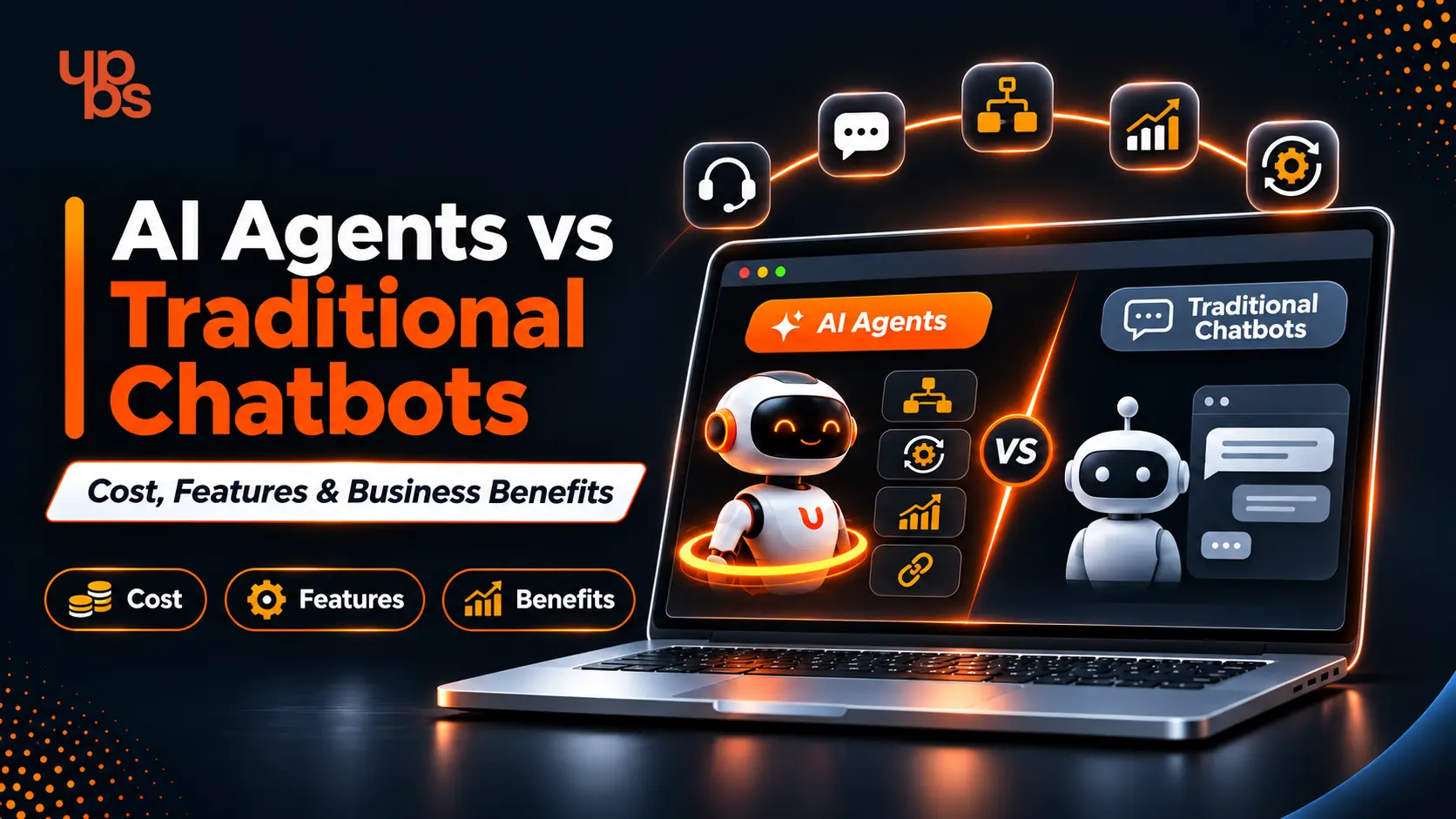
This brings us to an important question: AI agents vs. traditional chatbots—which solution is better for your business?
The answer depends on your business goals, budget, customer expectations, and the complexity of the tasks you want to automate. While traditional chatbots are suitable for simple customer interactions, AI agents can handle more complex workflows by using connected business tools and completing multiple steps toward a defined goal.
What Is a Traditional Chatbot?
A traditional chatbot is a software application designed to interact with users through text or voice conversations. It answers questions, provides information, and guides customers through predefined conversational flows.
For example, a chatbot on an e-commerce website might answer questions such as:
- What are your delivery charges?
- How can I track my order?
- What is your return policy?
- How can I contact customer support?
If a customer asks a question outside its programmed capabilities, the chatbot may provide a generic response or transfer the conversation to a human representative.
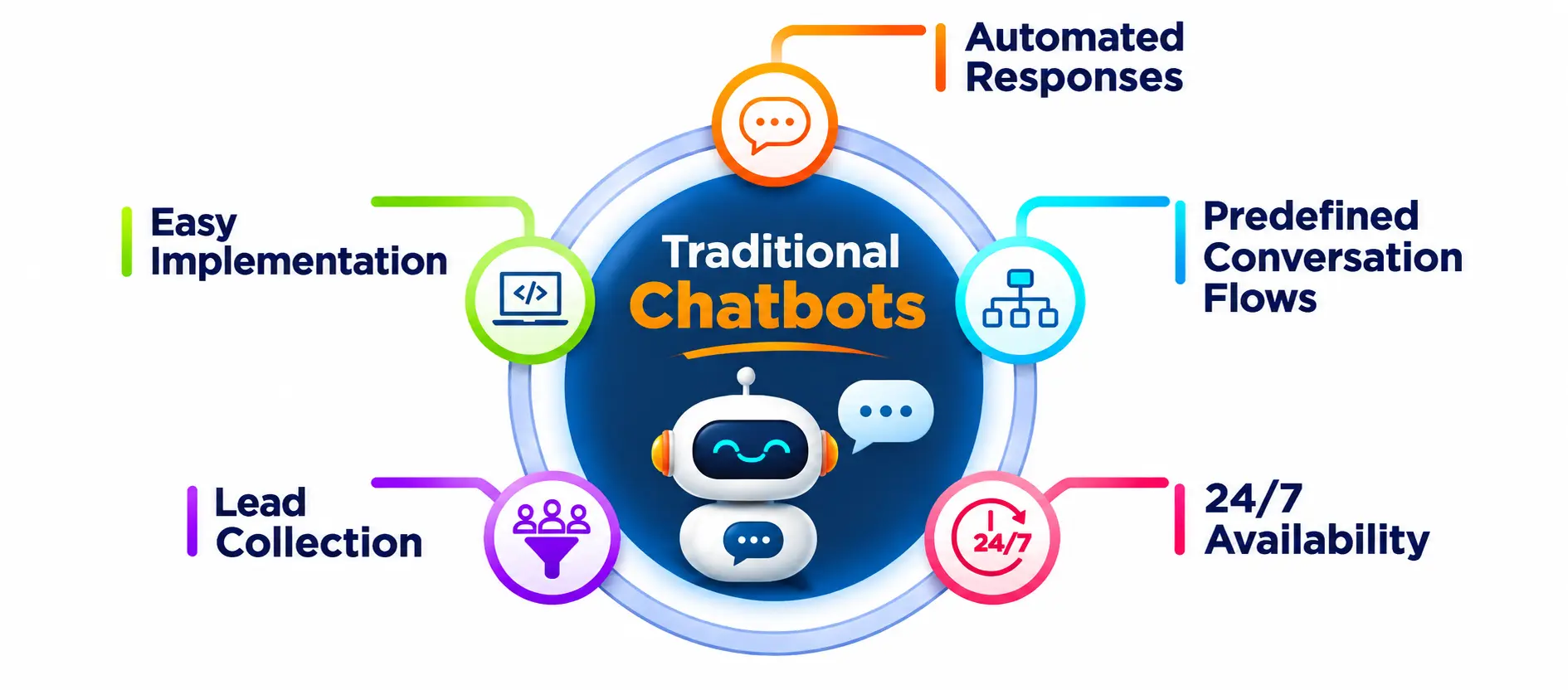
Key Features of Traditional Chatbots
- Automated responses: Answer frequently asked questions without requiring staff intervention.
- Predefined conversation flows: Guide customers through structured processes such as appointment requests, enquiry forms, and product selection.
- 24/7 availability: Provide basic information outside regular business hours.
- Lead collection: Collect customer names, contact details, and enquiry information.
- Easy implementation: Basic chatbots can often be deployed using existing platforms and templates.
Traditional chatbots are particularly useful for businesses that receive repetitive customer queries and want to improve response times without investing in complex automation.
What Are AI Agents?
AI agents are software systems that use artificial intelligence to pursue specific goals, make context-dependent decisions, and perform actions through connected tools and systems. Unlike a basic rule-based chatbot, an AI agent can interpret a request, determine the next steps, access relevant information, and execute an approved workflow.
For example, imagine a customer contacts an online store because an order has not arrived.
A traditional chatbot might explain the delivery policy or provide a tracking link. An AI agent could retrieve the order details, check the shipment status, identify a delay, create a support ticket, and send the customer an appropriate update—provided the required integrations and permissions are available.
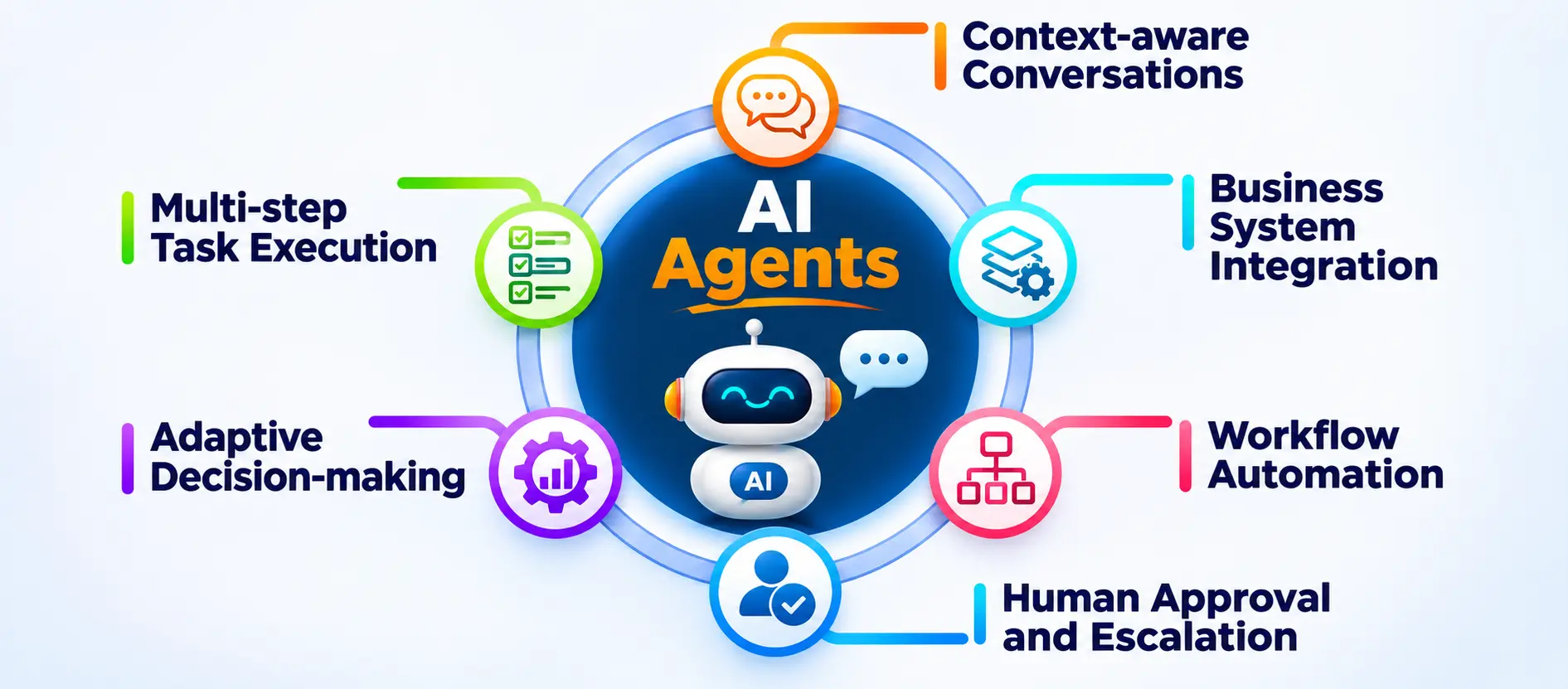
Key Features of AI Agents
- Context-aware conversations: Understand user intent and use relevant conversation history to provide more appropriate responses.
- Multi-step task execution: Break down a goal into smaller actions and coordinate them to complete a workflow.
- Business system integration: Connect with CRM platforms, databases, inventory systems, calendars, and other business applications.
- Adaptive decision-making: Handle variations in customer requests instead of relying entirely on fixed conversation paths.
- Workflow automation: Support processes such as lead qualification, customer follow-ups, ticket routing, and information retrieval.
- Human approval and escalation: Request human review when an action is sensitive, uncertain, or outside the agent's permissions.
The exact capabilities depend on the AI model, connected tools, data quality, system architecture, and safeguards implemented during development.
AI Agents vs. Traditional Chatbots: Key Differences
Although both technologies can improve customer communication, they differ in how they understand requests, make decisions, and complete tasks.
|
Comparison Factor |
Traditional Chatbots |
AI Agents |
|
Primary purpose |
Answer questions and guide conversations |
Achieve goals and complete tasks |
|
Working method |
Rules, scripts, or predefined flows |
AI reasoning, planning, tools, and defined constraints |
|
Decision-making |
Mostly predefined |
Context-dependent within configured limits |
|
Task complexity |
Simple and repetitive |
Multi-step and potentially dynamic |
|
Personalisation |
Based on configured rules and available data |
Can use context and connected customer information |
|
Integrations |
Basic or limited integrations |
Can coordinate multiple connected systems |
|
Automation |
Conversational tasks |
Conversations and operational workflows |
|
Development complexity |
Usually lower for basic implementations |
Often higher because of integrations and controls |
|
Maintenance |
Update scripts, rules, and knowledge |
Monitor outputs, permissions, integrations, and behaviour |
|
Best suited for |
FAQs, basic support, and enquiry collection |
Lead management, workflow automation, and complex support |
The main difference between AI agents and traditional chatbots is the ability to take action toward a goal rather than simply respond to a user.
It is also important to distinguish rule-based chatbots from modern AI chatbots. AI-powered chatbots can understand natural language and provide flexible responses without necessarily having the autonomy or system access required to operate as AI agents.
Business Benefits of Traditional Chatbots
Traditional chatbots remain valuable for businesses that want to automate common customer interactions without introducing unnecessary technical complexity.
1. Reduce Repetitive Customer Support Work
Customer support teams often answer the same questions repeatedly. A chatbot can provide standard answers about business hours, pricing, delivery policies, and service availability. This allows employees to focus on complex customer concerns that require personal attention.
2. Improve Response Times
Customers do not always want to wait for a sales representative to respond to a simple enquiry. A chatbot can provide immediate answers and guide users to relevant pages or contact forms. Faster responses can improve the customer experience and reduce friction during the buying journey.
3. Capture Leads Around the Clock
A website chatbot can collect contact information and basic requirements even when the sales team is unavailable. For example, a software development company can ask visitors about their project type, estimated budget, and expected timeline before forwarding the enquiry to its sales team.
4. Keep Customer Communication Consistent
A chatbot can deliver standardised answers based on approved information. This helps businesses maintain consistency across common customer interactions. For startups and small businesses, this can be a practical first step toward customer service automation.
Business Benefits of AI Agents
AI agents can offer broader operational benefits when businesses need more than automated conversations.
1. Automate Multi-Step Business Workflows
Many business processes involve several connected tasks. An employee may need to review a new enquiry, verify details, update a CRM, assign a sales representative, and schedule a follow-up. An AI agent can coordinate these steps through approved integrations, reducing manual effort and repetitive administrative work.
2. Improve Lead Qualification and Follow-Ups
For businesses that generate leads through their websites, delayed responses and inconsistent follow-ups can create missed opportunities. An AI agent can collect relevant information, qualify leads against predefined business criteria, update CRM records, and initiate approved follow-up workflows.
For example, a lead management agent for a software company could:
- Identify the service the prospect requires.
- Ask questions about project scope and timeline.
- Record the responses in the CRM.
- Assign the lead to the appropriate sales team.
- Schedule a follow-up or request approval for outreach.
These capabilities can help businesses organise their sales pipeline and respond to qualified prospects more efficiently.
3. Deliver More Contextual Customer Experiences
AI agents can use permitted customer information and conversation context to provide relevant assistance. For example, an agent supporting an existing customer could retrieve the customer's service plan, review previous support interactions, and suggest the appropriate next step.
This can reduce repeated questions and make customer interactions more efficient.
4. Connect Disconnected Business Systems
Employees often switch between multiple applications to complete a single task. AI agents can help coordinate information between connected tools, such as a CRM, ticketing platform, calendar, and internal database. The actual benefit depends on the quality and reliability of those integrations.
5. Support Business Growth
As a business grows, the volume of enquiries, support requests, and administrative tasks may increase. AI agents can help manage some of this additional workload without requiring every process to be handled manually. Businesses must still plan for monitoring, exception handling, human support, and additional usage costs.
Real-World Use Cases: AI Agents vs. Traditional Chatbots
Different industries can benefit from either technology depending on their operational requirements.
1. E-commerce Businesses
Traditional chatbot: Answers questions about shipping, returns, payment methods, and product availability.
AI agent: Can retrieve order information, coordinate approved return requests, check inventory, and update customer records through connected systems.
2. Healthcare Businesses
Traditional chatbot: Shares clinic timings, doctor availability, location details, and appointment instructions.
AI agent: May coordinate appointment scheduling, retrieve permitted administrative information, and send appointment reminders through approved integrations.
Healthcare implementations require particular care with patient privacy, access controls, and clinical safety. An administrative agent should not independently replace professional medical judgement.
3. Real Estate Companies
Traditional chatbot: Collects property preferences, budget ranges, and contact details.
AI agent: Can match enquiries against available listings, arrange property viewing requests, update CRM records, and coordinate follow-ups.
4. Software Development Companies
Traditional chatbot: Answers questions about development services, technologies, and project enquiry procedures.
AI agent: Can gather project requirements, classify enquiries by service, create CRM opportunities, schedule discovery calls, and route requests to the relevant team.
5. Education and Training Businesses
Traditional chatbot: Provides information about courses, fees, admission dates, and class schedules.
AI agent: Can help coordinate enquiry qualification, application status updates, scheduling, and administrative follow-ups where the relevant systems and permissions are available.
The best solution is the one that addresses an actual operational problem rather than simply adding AI to a business website.
AI Agents vs. Traditional Chatbots: Which Is Better for Small Businesses?
Small businesses do not always need an advanced AI agent. In many cases, a traditional chatbot is enough to solve immediate customer communication problems.
Consider a chatbot if your business:
- Receives a high volume of repetitive questions.
- Needs a simple website enquiry assistant.
- Wants to collect leads outside business hours.
- Has a limited automation budget.
- Does not require complex system integrations.
Consider an AI agent if your business:
- Handles complex, multi-step workflows.
- Loses leads because of delayed follow-ups.
- Uses several systems to complete repetitive tasks.
- Needs context-aware assistance.
- Wants to automate operational processes beyond conversations.
A third option is to combine both approaches. A website chatbot can act as the customer-facing interface, while an AI agent handles more complex tasks behind the scenes. This hybrid approach allows businesses to start with a manageable project and expand automation as their
How to Choose the Right Solution for Your Business
Choosing between AI agents and traditional chatbots becomes easier when you evaluate the problem before selecting the technology.
Step 1: Identify Your Biggest Business Challenge
Determine where your business loses the most time or opportunities.
Is your team spending hours answering repetitive questions? Are sales representatives missing follow-ups? Do employees manually transfer information between applications?
Clearly defining the problem will help you identify the right level of automation.
Step 2: Map the Existing Workflow
Document how the task is currently completed, including the people, tools, decisions, and approvals involved. This will help you determine whether a simple conversational flow is sufficient or whether the process requires an AI agent.
Step 3: Compare Development and Running Costs
Look beyond the initial development quote. Consider subscriptions, AI usage, hosting, integrations, maintenance, and employee time spent reviewing results. The most affordable solution upfront may not be the most cost-effective over time.
Step 4: Review Data and Integration Requirements
AI agents often depend on accurate business data and reliable connections to existing systems. Check whether your CRM, website, databases, and other applications can provide the necessary information and support the actions you want to automate.
Step 5: Define Permissions and Safety Controls
Decide which tasks the system can perform independently and which require approval. For example, an agent may be allowed to qualify leads automatically but require human approval before issuing refunds, changing important customer records, or making financial commitments.
Step 6: Start With a Small Pilot Project
Choose one repetitive, measurable workflow instead of automating every department at once. Track response accuracy, time saved, completion rates, escalation frequency, customer satisfaction, and total operating cost. Use these results to decide whether to expand the implementation.
Common Mistakes to Avoid When Implementing AI Automation
Even a technically advanced solution may fail to deliver value if it is not aligned with business needs.
Choosing AI Without a Clear Business Objective - Implementing an AI agent simply because the technology is popular can lead to unnecessary costs. Define the problem and success metrics before selecting the solution.
Ignoring Integration Costs - A system that works in isolation may not provide much value if employees still have to transfer information manually. Evaluate integration requirements during the planning stage.
Giving AI Agents Too Much Access - An AI agent should not have unrestricted access to sensitive systems or the authority to perform every action. Use least-privilege permissions, approval checkpoints, logging, and escalation procedures.
Using Poor-Quality Business Data - Incorrect service information, outdated policies, and incomplete customer records can lead to unreliable outputs. Review and organise your data before deployment.
Failing to Monitor Performance - Both chatbots and AI agents require ongoing evaluation. Monitor failed interactions, incorrect answers, unresolved requests, unexpected actions, and operating costs.
Expecting Complete Automation - Not every situation should be handled automatically. Human support remains important for sensitive decisions, unusual requests, complaints, and cases that exceed the system's capabilities.
How to Measure the ROI of AI Agents and Chatbots
Before investing in either solution, define how success will be measured.
Useful metrics include:
- Response time: How quickly customers receive an initial response.
- Resolution rate: The percentage of requests resolved without unnecessary escalation.
- Lead conversion rate: The percentage of qualified enquiries that become customers.
- Time saved: The number of employee hours saved through automation.
- Cost per interaction: The average cost of handling a customer request.
- Customer satisfaction: Feedback about the quality and usefulness of the interaction.
- Error rate: The frequency of incorrect responses or unsuccessful actions.
A simple ROI calculation is:
ROI (%) = [(Total Benefits − Total Costs) ÷ Total Costs] × 100
For example, if an automation project generates ₹2,00,000 in measurable benefits over a defined period and costs ₹1,00,000 in total, the ROI for that period is 100%.
This is an illustrative calculation, not a guaranteed business outcome. Benefits should be measured against a realistic baseline and include implementation, operating, and maintenance costs.
The Future of AI Agents and Chatbots in Business
The distinction between chatbots and AI agents is becoming less rigid as conversational AI systems gain access to tools, structured workflows, and business applications. Modern businesses can combine natural-language conversations with automated actions to support customers and employees more effectively.
For example, a future-ready customer service system may use a conversational interface to understand a request, retrieve information from internal systems, complete permitted actions, and escalate unresolved issues to a human representative.
Conclusion
The comparison of AI agents vs. traditional chatbots comes down to the level of automation your business actually needs. Traditional chatbots are a practical choice for answering common questions, capturing leads, and supporting straightforward customer interactions. AI agents are better suited to workflows that require contex tual decisions, multiple steps, and interactions with connected business systems.
Looking to implement AI-powered solutions for your business? UPBS Technology can help you explore custom software development and business automation options aligned with your operational requirements. Contact the team to discuss your project goals, integration needs, and implementation roadmap.
Frequently Asked Questions (FAQs)
- What is the main difference between AI agents and traditional chatbots?
Traditional chatbots primarily answer questions and guide users through conversations. AI agents can go further by planning steps, accessing connected tools, and performing approved actions to achieve a defined goal.
- Are AI agents more expensive than traditional chatbots?
AI agents often cost more to develop when they require custom workflows, multiple integrations, and advanced security controls. However, the actual cost depends on the project scope, technology, usage volume, and ongoing maintenance requirements.
- Can AI agents replace chatbots?
AI agents can provide chatbot-style conversations while also completing tasks. However, basic chatbots remain useful for simple requirements, and businesses can combine both technologies in one solution.
- Which is better for lead generation: an AI agent or a chatbot?
A traditional chatbot can collect contact details and answer initial questions. An AI agent can additionally qualify prospects, update CRM records, and coordinate follow-ups through connected systems. The better option depends on the complexity of your sales process.
- Can AI agents integrate with CRM software?
Yes. AI agents can integrate with supported CRM platforms through APIs or other integration methods. Depending on the configuration, they can retrieve customer information, update records, classify leads, and initiate approved workflows.