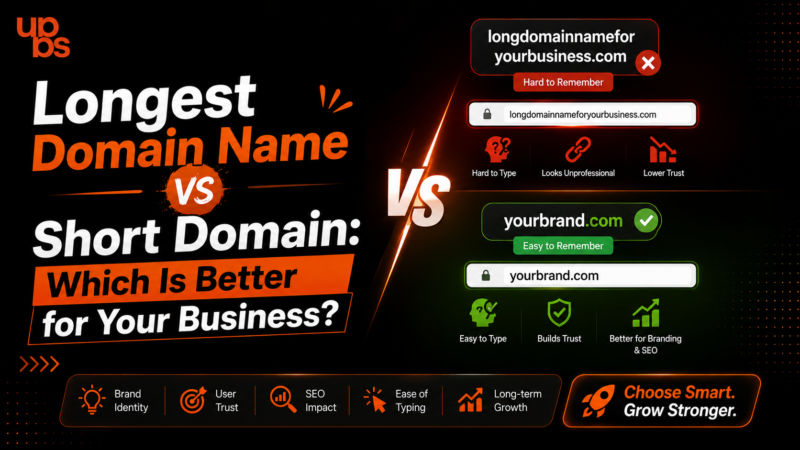
A domain name is much more than just a website address, it is the foundation of your online brand. Whether you're launching a startup, creating an ecommerce store, or building a company website, the domain name you choose influences how customers remember your business, trust your brand, and find you online. Many business owners spend hours comparing cheap domain names, while others wonder whether using long domain names with keywords will improve SEO. Some are even curious about the longest domain name allowed on the internet.
What Is a Domain Name?
A domain name is the unique web address people use to access your website on the internet. Instead of remembering a complex IP address such as 192.168.xx.xx, visitors simply type a memorable name like upbstechnology.com. Every website has a unique domain, making it the digital identity of a business. Without a domain name, customers would have a difficult time finding your website.
Why Is a Domain Name Important?
Your domain name helps you:
- Build a recognizable online brand
- Improve customer trust and credibility
- Create professional business email addresses
- Make your website easier to remember
- Support long-term digital marketing and SEO strategies
- Increase direct website traffic through brand searches
Think of your domain as your business's permanent online address. Changing it later can affect branding, SEO, and customer recognition, so it's worth choosing carefully from the start.
What Is the Short Domain Name?
A short domain name is a web address that typically contains one or two simple, memorable words with fewer characters. Short domains are easy to read, type, and remember, making them a popular choice for businesses looking to build a strong online brand.
Examples
- google.com
- nike.com
- zomato.com
- ola.com
Benefits of Short Domains
- Easy to Remember - People can recall shorter names much more easily than lengthy web addresses.
- Easier to Type - Typing a short domain on mobile devices reduces spelling mistakes and improves the user experience.
- Better Branding - Short domains look cleaner in advertisements, business cards, email signatures, and social media profiles.
- Higher Trust - Consumers often associate concise domain names with established and professional businesses.
- Better Word-of-Mouth Marketing - When someone recommends your website verbally, a short domain is much easier to communicate.

What Is the Longest Domain Name?
Many users search for the longest domain name because they are curious about internet rules. Technically, a fully qualified domain name can contain up to 253 characters, while each individual section (called a label) can contain up to 63 characters.
Although this is technically allowed, businesses almost never use extremely long domains because they create several practical problems:
- Difficult for users to remember
- High chance of spelling mistakes
- Poor appearance in advertisements
- Reduced trust among visitors
- Harder to share verbally
Just because the internet allows the longest domain name doesn't mean it's the best choice for a business website.

Do Long Domain Names Help SEO?
This is one of the biggest myths in SEO. Years ago, websites with exact-match keywords in their domain often ranked more easily. Today, Google's algorithms are much more advanced.
Google primarily evaluates:
- Helpful content
- Website authority
- Backlink quality
- User experience
- Page speed
- Mobile friendliness
- Search intent
Simply adding keywords into long domain names does not guarantee higher rankings.
For example: bestdigitalmarketingcompanyinnoida.com is not automatically better than upbstechnology.com if the second website has stronger content and better SEO, Content quality always matters more than domain length.
Difference Between Short vs Long Domain
Choosing between a short domain and a long domain name can impact your branding, marketing, and overall user experience. While both have their advantages, most businesses benefit from a domain that is simple, memorable, and easy to share.
|
Factor |
Short Domain |
Long Domain |
|
Branding |
Strong and memorable |
More descriptive |
|
User Experience |
Easy to type |
Higher chance of errors |
|
Marketing |
Better for promotions |
Less memorable |
|
SEO |
No direct advantage |
Keywords alone don't help |
|
Trust |
Looks professional |
Can appear less trustworthy |
Branding
Short domains help create a strong brand identity because they are easy to remember and recognize. Popular companies like Google, Amazon, Apple, and Shopify use short domain names to make their brands more memorable. While long domain names can describe a business better, they are generally less effective for long-term branding.
User Experience
Short domain names are easier to type on mobile devices and reduce spelling mistakes. They also fit better on business cards, QR codes, email signatures, and social media, making them more convenient for users to access and share.
Marketing
Short domains perform better in TV commercials, YouTube videos, podcasts, and digital advertisements because people can remember them more easily. Long domain names are often harder to recall, which can reduce the effectiveness of marketing campaigns.
SEO
A common myth is that long domain names with keywords rank higher in Google. In reality, Google focuses on content quality, website performance, backlinks, and user experience. A keyword-rich domain alone will not improve your rankings.
Trust
A clean and professional domain name helps build trust with visitors. Short domains often appear more credible and established, while overly long domain names may look complicated or less reliable. Choosing a simple and relevant domain creates a better first impression for your business.
How to Get Domain Name for Website?
If you're wondering how to get domain name for website, the process is simpler than you might think. Choosing the right domain is the first step toward building a professional online presence. Follow these steps to register and set up your domain correctly.
Step 1: Brainstorm Domain Name Ideas
Start by creating a list of domain name ideas that reflect your business, products, or services. Choose a name that is short, easy to spell, memorable, and relevant to your brand. Avoid using numbers, hyphens, or complicated words that may confuse users.
Step 2: Choose the Right Domain Extension
Your domain extension (also called a TLD) plays an important role in your website's identity.
- .com – Best for businesses and the most trusted extension worldwide.
- .in – Ideal for businesses targeting customers in India.
- .org – Commonly used by non-profit organizations, charities, and communities.
- .net – Suitable for technology companies, networks, and online services.
- .co – A good alternative to .com, often used by startups and modern businesses.
If possible, choose .com because it is the most recognizable and trusted by users.
Step 3: Check Domain Availability
Once you've selected a few domain name ideas, check whether they're available. If your preferred name is already registered, try slight variations while keeping the domain simple and brand-friendly.
Step 4: Register Your Domain
Purchase your domain through a trusted domain registrar. Before buying, compare registration costs, renewal fees, domain privacy protection, and customer support to avoid unexpected charges later.
Step 5: Connect Your Domain to Hosting
After registering the domain, connect it to your web hosting account by updating the DNS (Domain Name System) settings. This allows visitors to access your website when they enter your domain name.
Step 6: Create a Professional Business Email
Set up a custom email address using your domain, such as info@yourbusiness.com or support@yourbusiness.com. A professional email helps build credibility and creates a more trustworthy impression than using free email services.
Step 7: Enable an SSL Certificate
Install an SSL certificate to secure your website with HTTPS. SSL encrypts data between your website and visitors, protects sensitive information, improves customer trust, and is also a positive ranking factor for search engines like Google.
Why You Should Renew Your Domain Name on Time
Many businesses focus on registering a domain but forget the importance of renewing it. Failing to renew domain name registrations on time can cause serious problems, including website downtime, lost customers, and even the permanent loss of your domain. Renewing your domain before it expires helps protect your online presence and keeps your business running smoothly.
What Happens If Your Domain Expires?
If you don't renew your domain name before the expiration date, you may face several issues:
- Your website goes offline, making it inaccessible to visitors.
- Business email accounts stop working, preventing you from sending or receiving emails.
- Customers cannot access your products or services, which may result in lost sales and reduced trust.
- Someone else may register your domain once it becomes available, making it difficult or expensive to recover.
- Your SEO rankings may drop if search engines can no longer access your website, reducing your online visibility.
How to Avoid Losing Your Domain
To protect your website and brand, always keep track of your domain's expiration date. Most domain registrars offer automatic renewal, which renews your domain before it expires. It's also a good idea to keep your payment details updated and register your domain for multiple years if possible. Taking these simple steps ensures your website remains secure, accessible, and available to your customers at all times.
Domain Name Ideas for New Businesses
Choosing the right domain name is an important step in building a strong online presence. Instead of selecting a name randomly, create a strategy that aligns with your brand and supports your long-term business goals.
When brainstorming domain name ideas, keep these best practices in mind:
- Match your business name to strengthen brand recognition.
- Keep it short and simple so it's easy to remember and type.
- Choose a unique name that stands out from competitors.
- Use easy-to-spell words to reduce typing errors.
- Reflect your brand personality, whether it's professional, creative, or modern.
- Think globally by choosing a name that works well in different regions and is easy to pronounce.
If your preferred domain is unavailable, you can add keyword modifiers such as your service, industry, or location, but only if they sound natural. For example, upbsdigital.com or upbstechnology.com are more memorable than long, keyword-stuffed domains.
How UPBS Technology Can Help You?
Choosing the perfect domain name can be challenging, especially if you're launching a new business or rebranding an existing one. At UPBS Technology, we help businesses select domain names that are memorable, brand-friendly, and built for long-term growth.
Our team assists you with:
- Finding the best domain name ideas for your business.
- Registering cheap domain names from trusted providers.
- Choosing the right domain extension (.com, .in, .net, etc.).
- Setting up your domain with secure web hosting.
- Configuring professional business email addresses.
- Installing SSL certificates for website security.
- Managing domain renewals to ensure you never forget to renew domain name.
Whether you're creating your first website or expanding your online presence, UPBS Technology provides complete domain registration and website development services to help your business get started with confidence. A strong domain name is the foundation of a successful online brand, and we're here to help you choose one that supports your future growth.
Final Recommendation for Businesses
Choose a short domain if
You are building a long-term brand, running advertisements, or want customers to remember your website easily.
Choose a moderately long domain if
Your short option is unavailable and you need a descriptive name that clearly explains your service.
Avoid extremely long domains
Even though the internet allows the longest domain name lengths, they are difficult to remember, type, and market effectively.