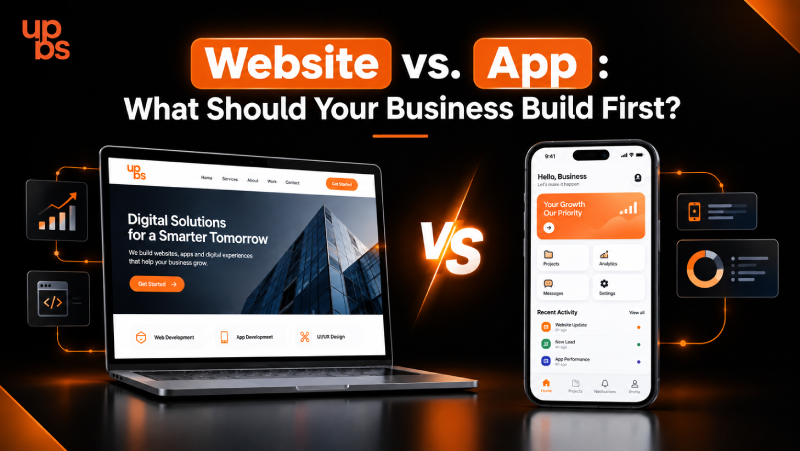
If you're planning your next digital move, you've probably run into the same question every founder eventually asks: should you build a website or an app? It's one of the most common business dilemmas today, and the answer isn't as simple as picking whichever sounds more "modern."
The real decision comes down to understanding your users, your budget, your timeline, and your long-term goals. This is exactly why the web app vs website debate matters because choosing wrong can cost you months of development time and a chunk of your budget. In this guide, we'll break down the differences, help you figure out what your business actually needs first, and show you how to make a smart, future-proof decision.
What's Inside: Building a Website vs. Building an App
Before you decide which direction fits your business, it helps to understand what actually goes into building each one and what happens once you decide "I want a website" versus "I want an app."
What Happens If You Choose a Website
Choosing a website means your focus is on visibility, information, and first impressions. The process typically involves planning your site structure, designing pages around your brand, and building it to load fast and rank well on search engines. Budget-wise, this is usually the lighter option to start with, but costs still shift based on design complexity, number of pages, and features like e-commerce or booking systems. Knowing the website development cost (Plan your budget right) upfront helps you set realistic expectations before development even begins.
What Happens If You Choose an App
Choosing an app means you're building for deeper, repeated user engagement not just a first look, but a daily habit. This involves more moving parts: deciding between native, hybrid, or web app, mapping out user flows, and designing an interface that feels intuitive from the very first tap. Since usability makes or breaks an app, design decisions carry more weight here than on a typical website. Understanding what UI/UX companies do (See the difference design makes) differently often explains why some apps retain users while others get uninstalled within days.
What's the Difference Between a Website and an App?
Before diving into the web app vs website comparison, it helps to understand what each one actually is.
A website is a collection of web pages accessed through a browser think of it as your digital storefront. It's where people learn about your business, browse your services, read your blog, or make a purchase. A web app, on the other hand, is more interactive. It behaves more like software, letting users log in, manage accounts, complete transactions, or perform tasks within the platform itself.
Key distinctions to keep in mind:
- Websites are informational and static or semi-dynamic (blogs, landing pages, portfolios)
- Web apps are interactive and functional (dashboards, booking systems, SaaS platforms)
- Native apps live on app stores and use device features like camera, GPS, and push notifications
- Both websites and web apps run in a browser, but web apps offer app-like functionality without needing a download
Understanding this distinction is the foundation for every decision that follows.
When Should Your Business Choose a Website First?
For most new businesses, a website is the right starting point. It's faster to build, more affordable, and it's exactly where customers expect to find you first through Google search, social media links, or word of mouth.
A website makes sense when your primary goal is visibility, credibility, and information sharing. If you're a local business, a service provider, or a brand that wants to showcase products without complex user accounts, a well-built website covers most of your needs. UPBS Technology's website development services (See what we build) are designed exactly for this helping businesses launch fast without compromising on design or performance.
A website is usually the better first move if:
- You need an online presence quickly
- Your business model doesn't require user logins or complex data handling
- SEO and organic discovery are priorities
- Budget is limited and you need to launch lean

When Should You Build an App Instead?
Apps come into play when your business needs deeper user engagement think loyalty programs, personalized dashboards, real-time notifications, or offline functionality. If your customers need to interact with your platform frequently, an app can create stickiness a website simply can't match.
That said, apps are a bigger investment. They require ongoing updates, app store approvals, and separate development for iOS and Android (unless you go cross-platform). Businesses considering this route often explore UPBS's app development services (Build it right) to understand which approach native, hybrid, or web app fits their goals and budget best.
Consider building an app when:
- Your users need frequent, repeat interaction
- You want to leverage device features like push notifications or camera access
- Offline access is important to your use case
- You're building a product-led business, not just a service brand
Web App vs Website: Which One Solves Your Business Problem?
This is really the core of the web app vs website question it's not about which technology is "better," it's about which one solves your specific business problem. If you're running or planning to launch an online store, this decision becomes even more important. A website with e-commerce functionality might be enough, or you might need something closer to a full web app for inventory management, customer accounts, and order tracking. Businesses weighing this exact trade-off often benefit from comparing custom e-commerce development (Which fits you best?) against off-the-shelf platforms before committing to a direction.
Ask yourself these questions to narrow it down:
- Do customers need to create accounts or track orders?
- Is your product/service transactional or purely informational?
- Do you need real-time updates or notifications?
- How complex is the user journey you're designing?
The more "yes" answers you have to interactivity-based questions, the more you're leaning toward a web app.
Cost, Time & Maintenance Comparison
Budget and timeline are often the deciding factors in the web app vs website decision, so it's worth being realistic here. A standard business website can typically go live in a few weeks, while a functional web app or native app can take several months depending on complexity. Costs scale accordingly a website might need a modest one-time investment, while an app involves ongoing development, testing, and updates.
But there's a piece founders often overlook: whatever you build, it needs continued care. Outdated plugins, broken links, and security vulnerabilities pile up over time, and ignoring them hurts both performance and trust. Recognizing the early website maintenance (Don't skip this) warning signs can save you from a much bigger fix later.
Rough comparison:
- Website: Lower upfront cost, faster launch, lighter ongoing maintenance
- Web app: Higher upfront investment, longer build time, continuous updates required
- Native app: Highest cost, app store dependency, platform-specific maintenance
Do You Need Both? Website + App Strategy
Here's something many businesses miss: it doesn't always have to be a website or app. As you grow, you may need both working together. Your website handles marketing, SEO, and first impressions, while your app or web app manages the operational side of your business.
For example, a growing business might use its website to attract leads and its backend to manage them through a custom CRM development (Streamline your operations) system keeping customer data, follow-ups, and sales pipelines organized in one place. This combination often becomes essential once you move past the "just getting started" phase.
Signs you might need both:
- Your website traffic is growing but conversions are getting harder to manage manually
- You're juggling customer data across spreadsheets or disconnected tools
- Your team needs an internal system while customers still need a public-facing site
Real-World Examples: Website vs Web App in Action
Sometimes the easiest way to understand the web app vs website decision is through real business scenarios rather than theory. Take a local restaurant, for example. It needs a website to display its menu, location, hours, and photos. Customers just want quick information before they visit or call. There's no need for logins, dashboards, or complex interactivity. A clean, fast, SEO-friendly website does the job perfectly.
Now compare that to a business offering online tutoring or subscription-based coaching. Customers need to log in, track their progress, book sessions, and receive reminders. A simple website can't support that kind of ongoing interaction; this is where a web app becomes essential, not optional.
A few more examples worth considering:
- Retail store with a few products: A website with basic e-commerce is usually enough
- Marketplace connecting buyers and sellers: Needs a web app with accounts, messaging, and transactions
- Consulting or agency business: A website focused on credibility, portfolio, and lead generation
- Fitness or wellness brand with memberships: A web app to manage bookings, plans, and progress tracking
Seeing your own business reflected in one of these patterns often makes the decision much clearer than reading feature comparisons alone.
How SEO Fits into Your Website vs Web App Decision
No matter which direction you choose, visibility matters and this is where a lot of businesses underestimate the impact of their decision. Websites are generally easier to optimize for search engines because content, pages, and metadata are more accessible to crawlers. Web apps, especially single-page applications, often need extra technical work to remain search-friendly.
If organic traffic and long-term discoverability are part of your growth plan, this should heavily influence your web app vs website choice. Partnering with a team that understands technical SEO including UPBS's SEO services (Get found online) ensures that whatever you build doesn't get lost in search results after launch.

Quick Checklist: How to Make the Final Call
If you're still weighing the web app vs website decision, running through a short checklist can help you reach clarity faster than endless research.
Ask yourself:
- Is my main goal visibility and information sharing, or ongoing user interaction?
- Do I have the budget and timeline for continuous updates and app maintenance?
- Will my customers expect to log in, track data, or receive notifications regularly?
- Is my priority ranking on Google, or building a loyal, repeat-user base?
- Am I validating a new idea, or scaling an already-proven business model?
If most of your answers point toward information, discovery, and credibility, a website is your starting point. If they lean toward engagement, personalization, and repeat usage, a web app deserves serious consideration. And if you find yourself answering "both" more than once, that's usually a sign your business has outgrown a single-solution approach.
Why Choose UPBS Technology for Your Website or App Development
Making the right call between a website and an app isn't a decision you should make alone and it's not one-size-fits-all either. UPBS Technology has helped businesses across industries evaluate their goals, budgets, and user needs before recommending the right path forward, rather than pushing a one-size solution.
As a trusted website development company in Noida (Local experts, real results), UPBS combines technical expertise with a business-first approach meaning every recommendation, whether it's a website, a web app, or both, is built around what will actually move your business forward. From development to long-term support, the goal is always the same: build something that works for your users and grows with your business.
Final Thoughts
The web app vs website decision ultimately comes down to your business model, your customers, and your growth stage. A website is often the smart first step for visibility and credibility, while a web app becomes valuable once user engagement and functionality take priority. For many growing businesses, the real answer is a strategic mix of both built and maintained by a team that understands the full picture.
If you're still unsure where to start, talking to a development team that can assess your specific goals will save you time, money, and a lot of guesswork. The right choice isn't about following trends, it's about matching your platform to how your customers actually behave, what your team can realistically maintain, and where your business is headed over the next few years. Get that alignment right, and whether you launch a website, a web app, or both, you'll be building on a foundation that supports growth instead of holding it back.