
Instagram has become a competitive platform for creators, influencers, startups, and established businesses. Publishing high-quality content is important, but making sure the right audience discovers that content is equally essential. This is where a well-planned Instagram hashtag strategy can help.
Using relevant hashtags can help categorize your content and make it easier for interested users to discover your posts. However, adding dozens of random hashtags is not a reliable shortcut to more views, followers, or engagement. Understanding Instagram SEO is an important part of improving content discoverability. Explore our beginner's guide to SEO to learn how keyword research and content optimization support online visibility.
What Are Instagram Hashtags?
Instagram hashtags are words or phrases preceded by the hash symbol (#). They help categorize content around particular subjects, interests, industries, and communities. For example, a fashion creator posting a winter outfit Reel might use hashtags such as #WinterFashion, #WinterOutfits, and #AffordableFashion.
When users explore related hashtags or search for relevant topics, properly categorized content may become easier to discover. Businesses looking to build a stronger online presence can benefit from professional social media marketing services that combine content planning, audience engagement, and performance analysis.
Why Are Instagram Hashtags Important in 2027?
Hashtags remain a useful element of Instagram content optimization when they accurately describe what you publish.
Here are some reasons to include them in your social media strategy.
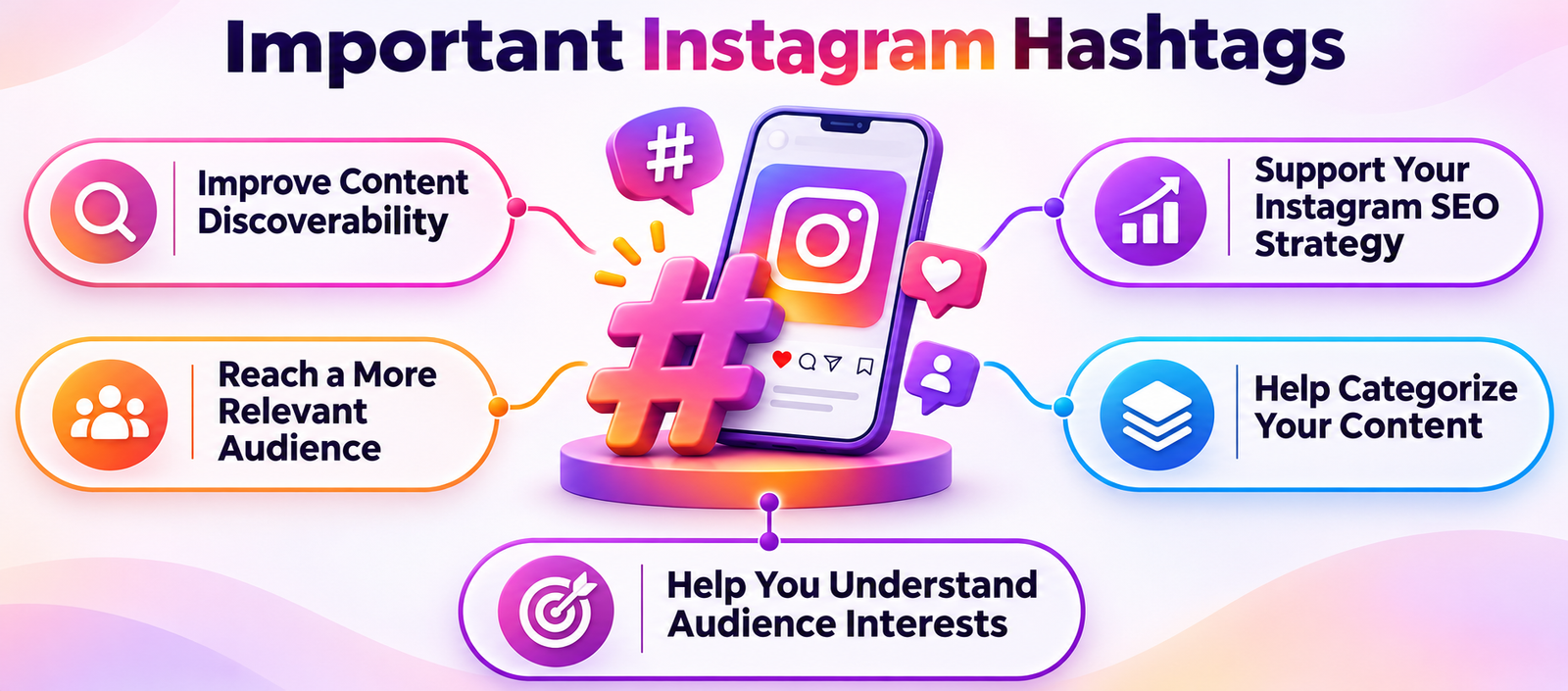
1. Improve Content Discoverability
Relevant hashtags help associate your content with specific topics. This can create additional opportunities for people interested in those subjects to find your posts.
2. Reach a More Relevant Audience
Specific hashtags can help attract people who are interested in your niche rather than a broad audience with little connection to your content. For example, a post about affordable ethnic wear may be more relevant to #AffordableEthnicWear than to a generic tag such as #Love.
3. Support Your Instagram SEO Strategy
Instagram search can consider text in captions, usernames, bios, hashtags, and other relevant signals. Using descriptive language and appropriate hashtags can help make your content easier to understand and find.
For stronger Instagram SEO, combine hashtags with clear captions, relevant keywords, and a profile that accurately describes your niche.
4. Help Categorize Your Content
Consistent, relevant hashtags make it easier to organize content around product categories, campaigns, locations, and recurring themes. This is particularly useful for businesses managing multiple services or products.
5. Help You Understand Audience Interests
Testing different relevant hashtag groups alongside different content formats can help you understand which topics attract attention from your target audience. However, evaluate hashtags alongside other factors rather than assuming that a hashtag alone caused a change in performance.
Step-by-Step Guide to Finding the Best Instagram Hashtags in 2027
Follow these steps to create a hashtag strategy that aligns with your content and business objectives.
Step 1: Define Your Content Niche
Before searching for hashtags, identify the main subject of your content and the audience you want to reach. A clear niche makes hashtag research easier because it narrows down the topics and interests relevant to your posts.
For example:
- Fashion creators: outfit inspiration, seasonal fashion, ethnic wear, and affordable styling.
- Digital marketing agencies: SEO, social media marketing, content marketing, and online advertising.
- Fitness creators: workout routines, strength training, healthy habits, and exercise tutorials.
- E-commerce businesses: product discovery, shopping tips, product demonstrations, and customer experiences.
- Local businesses: location-specific services, local events, and community topics.
Action tip: Write down three to five core topics that describe your account. Use these topics as the starting point for your hashtag research.
Step 2: Research Relevant Hashtags on Instagram
Instagram itself is a useful place to begin your research.
Follow this process:
- Open Instagram and navigate to Search.
- Enter a keyword that describes your content.
- Explore related search suggestions and relevant content.
- Review posts published by creators and businesses in your niche.
- Identify hashtags that accurately describe the topic, audience, or purpose of your content.
- Save promising hashtags in a research document or spreadsheet.
Do not select a hashtag simply because it appears frequently. Review the content associated with it to determine whether the audience and subject matter match your goals.
For example, if you publish a Reel featuring an affordable winter jacket, research terms related to winter outfits, affordable clothing, jacket styling, and winter fashion finds.
Step 3: Understand the Different Types of Instagram Hashtags
An effective hashtag strategy includes different types of relevant tags rather than relying on one broad category.
Broad hashtags - These describe general topics and may attract a wide range of content.
Examples: #Fashion, #Marketing, #Fitness
Niche hashtags - These describe a more specific subject or audience.
Examples: #EthnicWearInspiration, #LocalSEO, #HomeWorkoutTips
Community hashtags - These connect content with people who share a particular interest or activity.
Examples: #FashionCommunity, #SmallBusinessOwners, #FitnessCommunity
Branded hashtags - These are created around your business, campaign, or recognizable brand identity.
Examples: #YourBrandName, #YourBrandNameTips
Location-based hashtags - These identify a city, neighborhood, or local community when location is relevant to the post.
Examples: #NoidaBusiness, #DelhiFashion
Use the categories that make sense for each post. You do not need to include every type in every caption.
Step 4: Choose a Focused Set of Relevant Hashtags
One common mistake is assuming that more hashtags automatically mean more reach. Instead, prioritize relevance and follow Instagram's current in-app hashtag limits and recommendations. A focused set of three to five highly relevant hashtags is a practical starting point for testing your strategy.
For example, a Reel showcasing an affordable winter outfit could use:
#WinterFashion #AffordableFashion #WinterOutfits #BudgetStyle #WinterStyleInspiration
Every hashtag should accurately describe the content or the audience you want to reach.
Avoid unrelated trending tags, repetitive filler, and hashtags added only because they are popular.
Step 5: Find a Balance Between Popular and Specific Hashtags
Popular hashtags can expose your content to broad topics, but they also contain substantial competition. Specific hashtags can connect your content with a narrower, more relevant audience.
A balanced selection may include a broad topic, a niche subject, and a hashtag describing the content's intended audience. For example, a digital marketing agency publishing an SEO tips Reel might use:
#DigitalMarketing #SEOtips #SmallBusinessSEO #SEOstrategy
These tags cover the general industry as well as the specific subject and audience. There is no universal popularity threshold that guarantees better results. Choose hashtags based on their relevance and the kind of content users find under them.
Step 6: Optimize Your Instagram Captions With Keywords
Hashtags should complement your caption rather than replace meaningful text. Write a natural caption that clearly explains what your content offers. Include relevant keywords where they fit, especially in the opening lines. Along with relevant hashtags, following effective digital marketing best practices can help businesses create more discoverable content and maintain consistent messaging across digital channels.
For example, instead of writing:
"New look! Must watch! #Fashion #Style #Trending"
Try:
"Looking for affordable winter outfits? Here are three easy styling ideas for creating a stylish everyday look on a budget. #WinterFashion #AffordableFashion #WinterOutfits"
The second caption provides clearer context about the content and its intended audience. Avoid keyword stuffing. Captions should be written for people first, with discoverability in mind.
Step 7: Use Relevant Hashtags for Instagram Reels
Reels are an important format for creators and businesses that want to share short-form videos. Hashtags can support topic classification, but they cannot compensate for a video that fails to interest its audience.
Follow these Reel optimization practices:
- Use hashtags that describe the actual video.
- Include the main topic naturally in the caption.
- Create an opening hook that gives viewers a reason to keep watching.
- Use clear visuals, readable on-screen text, and relevant audio.
- Encourage meaningful actions, such as saving a useful tutorial or sharing a helpful tip.
- Review watch time, shares, saves, and reach to understand performance.
For example, a Reel demonstrating three ways to style a denim jacket could use #DenimJacketOutfit, #CasualStyle, and #EverydayFashion.
The objective is to help the right audience understand the video and find it relevant, not simply to accumulate views.
Step 8: Create a Branded Hashtag for Your Business
A branded hashtag can help organize campaigns and encourage customers or community members to share related content. Choose a short, memorable hashtag associated with your business name, campaign, or content series.
Before using it, search Instagram to check whether other accounts are already using the same phrase in an unrelated context. You can then include your branded hashtag in relevant campaign posts and encourage users to participate when appropriate.
Remember that creating a branded hashtag does not automatically make it popular. Consistent use and meaningful audience participation are what make it useful.
Step 9: Track Hashtag and Content Performance
A successful Instagram hashtag strategy requires ongoing evaluation. Use Instagram Insights, where available, to monitor content performance and identify which posts are attracting the right audience.
Track metrics such as:
- Accounts reached and non-follower reach.
- Reel views and watch time.
- Shares and saves.
- Profile visits and follows.
- Website clicks, enquiries, or other business outcomes.
Compare posts with similar topics and formats. Change one element at a time when practical, such as the hashtag selection or caption wording, so you can better understand what may have influenced the results.
To understand how social media content contributes to wider marketing goals, explore these social media marketing insights and learn how businesses can improve engagement and generate leads.
Step 10: Update Your Hashtag Strategy Regularly
Hashtag relevance can change as audience interests, seasonal topics, and content trends evolve. Review your hashtag list periodically and remove tags that no longer fit your content.
For seasonal campaigns, research relevant terms before publishing. For ongoing content, retain hashtags that remain accurate and useful.
A simple monthly review can include:
- Identifying your strongest-performing posts.
- Reviewing the hashtags used on those posts.
- Checking whether those hashtags remain relevant.
- Testing a small number of alternative hashtags.
- Updating your saved hashtag groups based on your findings.
Consistency and experimentation are more useful than changing your entire strategy after every post.
Best Instagram Hashtags by Industry in 2027
The following examples can help you start your research. They are suggested starting points, not verified rankings of the most popular or highest-performing hashtags.
1. Fashion and Lifestyle
#FashionInspiration #OOTD #AffordableFashion #WinterOutfits #EthnicWear
Use these as starting points for outfit inspiration, clothing reviews, styling videos, and fashion product content. Replace general tags with more specific terms when your post focuses on a particular garment, occasion, or audience.
2. Digital Marketing
#DigitalMarketing #SocialMediaMarketing #ContentMarketing #MarketingStrategy #DigitalGrowth
These hashtags may suit educational posts, marketing tips, campaign insights, and digital business content.
3. SEO and Website Development
#SEO #SEOStrategy #WebsiteDevelopment #WebDesign #TechnicalSEO
Use these tags for content about website performance, search optimization, web design, and development strategies.
4. Small Businesses and Entrepreneurs
#SmallBusiness #Entrepreneurship #BusinessGrowth #SmallBusinessTips #StartupTips
These can support posts offering practical advice to business owners, founders, and entrepreneurs.
5. Fitness and Wellness
#FitnessTips #WorkoutRoutine #StrengthTraining #HealthyHabits #FitnessMotivation
Choose tags that accurately represent the activity shown and the intended audience. Avoid using broad wellness hashtags on content that does not relate to them.
6. Food and Cooking
#HomeCooking #EasyRecipes #FoodInspiration #CookingTips #RecipeIdeas
These hashtags can help categorize recipe demonstrations, cooking tutorials, meal ideas, and food-related content.
Important: Do not copy and paste the same hashtag group into every post. Select tags according to each post's actual subject, audience, and purpose.
Instagram Hashtag Mistakes to Avoid in 2027
Even a well-planned content calendar can become less effective when hashtags are used without a clear strategy.
Using Irrelevant Trending Hashtags - A trending hashtag may attract attention from people who have no interest in your content. Choose relevance over temporary popularity.
Repeating the Same Hashtags on Every Post - Using an identical hashtag group regardless of the topic can make your content categorization less precise. Build a small library of relevant hashtag groups and adapt them for each post.
Using Only Broad Hashtags - Broad hashtags may cover a large subject, but they do not always describe your specific content. Include more descriptive niche terms when appropriate.
Ignoring Caption Keywords - Hashtags alone do not provide complete context. Write captions that clearly explain the subject, benefits, and intended audience of your content.
Expecting Hashtags to Guarantee Viral Reach - No hashtag can guarantee viral results. Content quality, viewer interest, watch time, sharing behavior, and other ranking signals can all influence distribution.
Failing to Measure Results - Without reviewing performance, you may continue using hashtags that do not align with your goals. Track meaningful metrics and make gradual improvements.
How to Build an Instagram Hashtag Strategy for Your Business
For businesses, hashtags should support wider marketing objectives instead of operating as an isolated growth tactic. Start by identifying your target customers and the subjects they are likely to search for. Research relevant keywords, create informative content, and select hashtags that accurately describe each post.
For example, a web development company could publish content about website speed, mobile responsiveness, e-commerce functionality, and common website mistakes. Relevant hashtags can complement those topics, while clear captions help communicate the value of each post.
Businesses should also connect Instagram activity with broader marketing efforts, including website content, search engine optimization, social media campaigns, and lead generation. A coordinated strategy helps maintain consistent messaging and gives potential customers more opportunities to understand your expertise.
Frequently Asked Questions
- How Many Hashtags Should I Use on Instagram in 2027?
Start with three to five relevant hashtags that describe your content and target audience. For example, a winter fashion Reel could use #WinterFashion, #AffordableFashion, and #WinterOutfits. Focus on relevance rather than adding hashtags just to increase reach.
- Do Instagram Hashtags Still Work in 2027?
Yes, hashtags can help categorize content and improve discoverability. However, Instagram growth also depends on content quality, audience interests, engagement, and viewing behavior. Combine relevant hashtags with keyword-rich captions and engaging visuals for a more effective strategy.
- How Do I Find the Best Hashtags for Instagram Reels?
Search Instagram for keywords related to your Reel and explore relevant hashtags used by similar creators. Choose tags that match your video's topic and audience. Monitor reach, shares, saves, and watch time to understand which content strategies work best.
- Can Hashtags Help Increase Instagram Followers?
Hashtags can help new audiences discover your content, but gaining followers depends on what they see next. Publish valuable, engaging content, maintain a clear profile bio, and stay consistent with your niche to encourage profile visitors to follow your account.
- How Often Should I Change My Instagram Hashtags?
Review your hashtags monthly or whenever your content strategy changes. Keep relevant hashtags, replace unrelated ones, and test alternatives gradually. Use Instagram Insights to compare performance and identify patterns that can improve your future posts.
Conclusion
Building an effective Instagram hashtag strategy in 2027 is about relevance, research, and continuous improvement rather than using the largest possible number of tags.
Start by defining your niche, researching audience interests, selecting a focused set of hashtags, and writing descriptive captions. Then monitor content performance and refine your approach based on meaningful results.
For creators, this can help keep content aligned with the right audience. For businesses, it can support a broader strategy focused on online visibility, audience engagement, and measurable growth.
Combine relevant hashtags with valuable content, Instagram SEO, and consistent performance analysis to build a more sustainable social media presence. Want to strengthen your brand's online visibility? Explore UPBS Technology's digital marketing and SEO services to discover how a coordinated digital strategy can support your business growth.