When a family starts looking for a school, college, or coaching institute, the journey almost always begins with a Google search. They compare fees, courses, results, and reviews across several options before they ever visit a campus or fill out an enquiry form. If your institution does not appear on the first page for the searches that matter, those admissions quietly go to the competitor who does.
SEO for educational institutions is the practice of improving your website so that students and parents can find you at exactly that moment of search. A well-planned SEO strategy goes beyond keywords. It combines technical SEO, local SEO, helpful content, a smooth user experience, and authority building, so that search visitors turn into real admission enquiries. In this guide, you will learn which strategies work in 2026, how long results take, how to measure success, and how to convert visitors into admissions.
What is SEO for Educational Institutions?
SEO (Search Engine Optimization) for educational institutions is the process of improving your website’s visibility on search engines to attract students, parents, and learners.
It focuses on:
- Increasing organic traffic
- Targeting admission-related keywords
- Building credibility and authority
- Generating high-quality leads
In 2026, SEO is not just about rankings, it's about reaching the right audience at the right time and guiding them from search to admission.
Biggest SEO Challenges for Educational Institutions
Many educational institutions invest in beautiful websites but struggle to attract students through search engines. The biggest challenge is not having a website, it's making that website visible when students and parents search online.
Some of the most common SEO challenges include:
- High competition from other schools, colleges, and universities.
- Poor optimization of course and admission pages.
- Slow website loading speed.
- Outdated content that doesn't answer students' questions.
- Weak local SEO, making it difficult to appear in Google Maps.
- Lack of quality backlinks from trusted education websites.
- Missing structured data and technical SEO issues.
Educational institutions that regularly optimize their websites, publish helpful content, and improve technical SEO are more likely to attract qualified traffic and increase admissions.
SEO Strategies for Different Types of Educational Institutions
Not every educational institution has the same SEO requirements. A school, university, coaching institute, and EdTech company all target different audiences. Their SEO strategy should reflect those differences.
| Institution Type | Primary SEO Focus |
|---|---|
| Schools | Local SEO, parent-focused keywords, admission pages |
| Colleges | Course pages, program-specific keywords, faculty profiles |
| Universities | Research content, academic programs, international SEO |
| Coaching Institutes | Location-based SEO, exam-specific landing pages |
| EdTech Platforms | Informational blogs, online courses, topical authority |
Understanding your audience helps create content that matches search intent and improves rankings.
Local SEO for Educational Institutions
Local SEO plays a major role in attracting nearby students and parents. When someone searches for phrases like "best school near me" or "engineering college in Noida," Google prioritizes locally optimized websites.
To improve local SEO:
- Optimize your Google Business Profile.
- Maintain consistent Name, Address, and Phone Number (NAP) across directories.
- Encourage genuine student and parent reviews.
- Create city-specific landing pages.
- Add Google Maps to the contact page.
- Use local keywords naturally throughout your website.
A strong local SEO strategy increases visibility in both Google Search and Google Maps, helping educational institutions generate more admission inquiries.
How Content Marketing Supports SEO for Educational Institutions
Content marketing is one of the most effective ways to improve SEO. Instead of focusing only on admissions pages, educational institutions should publish informative content that answers students' and parents' questions.
Some high-performing content ideas include:
- Admission guides
- Career counseling articles
- Course comparison blogs
- Scholarship information
- Student success stories
- Campus life guides
- Entrance exam preparation tips
- Frequently asked questions
Publishing valuable content consistently helps build authority, increase backlinks, and improve keyword rankings over time.
Understanding Search Intent in Education SEO
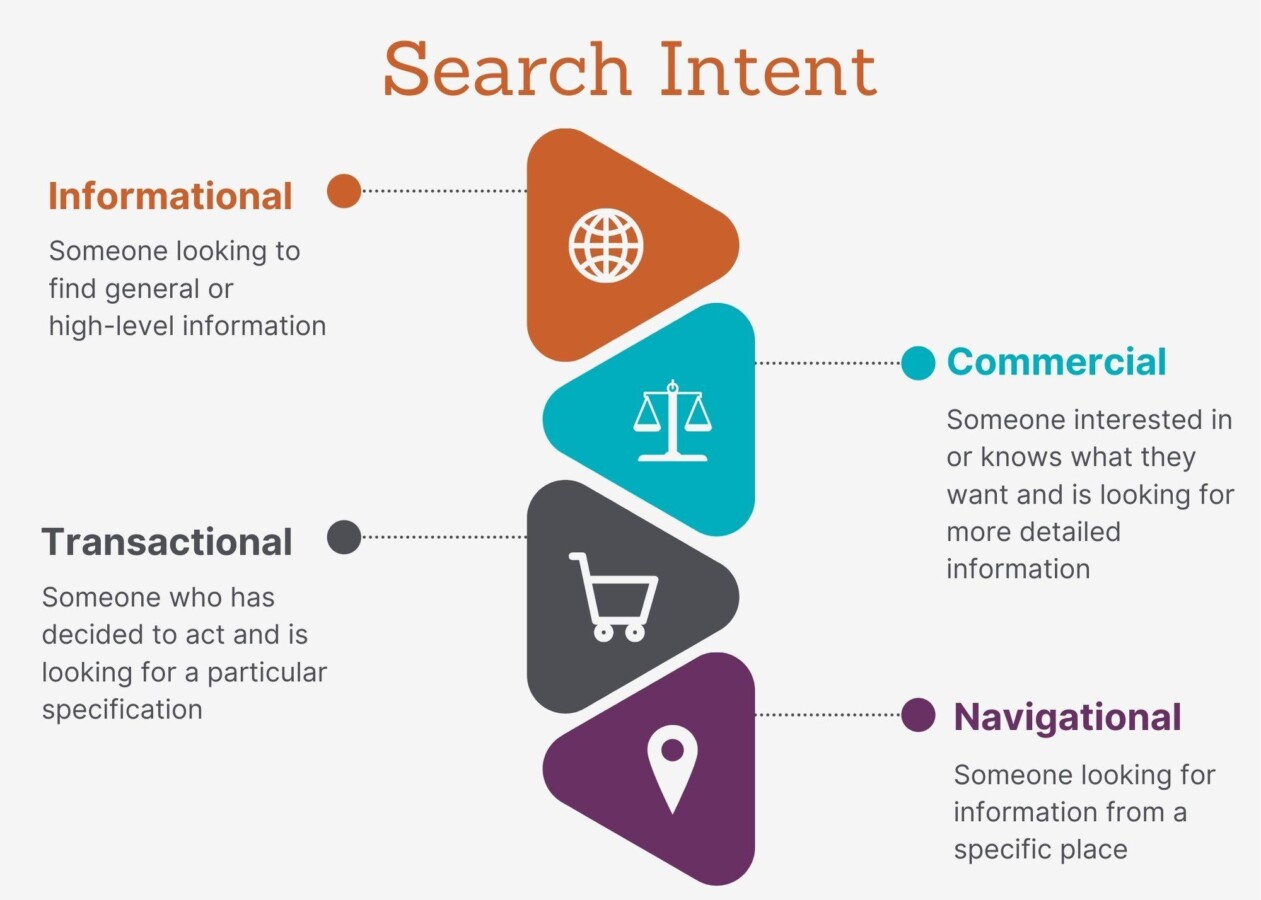
Search intent refers to the purpose behind a user’s query whether they are looking for information, a specific website, or ready to take action like applying for admission.
Types of Search Intent in Education SEO
- Informational (Awareness Stage)
Users are researching and exploring career or course options.
Example: “best career options after 12th”
Create blogs, guides, and FAQs to educate users and build trust. This stage helps bring maximum organic traffic. - Navigational
Users already know about your institution and want to visit your website.
Example: “XYZ college official website”
Optimize your homepage, brand keywords, and ensure your website appears on top for branded searches. - Transactional (Decision Stage)
Users are ready to take action like applying for admission or making an inquiry.
Example: “apply for BBA admission 2026”
Create dedicated admission pages with strong CTAs like Apply Now, Book a Demo, or Enquire Now to increase conversions.
4. Local Intent
Users are searching for institutions in a specific city or nearby area.
Example: “top schools near me”
Use location-based keywords, optimize your Google Business Profile, and collect reviews to improve local rankings.
Advanced Keyword Research Strategy for 2026
In 2026, keyword research is no longer just about finding high-volume keywords. Search engines now prioritize user intent, topic relevance, and content depth. That’s why focusing on topic clusters instead of single keywords is essential for better SEO performance.
Key Focus Areas
- Long-tail keywords: More specific phrases with lower competition and higher conversion potential
(e.g., “best MBA college in Noida with placement”) - Question-based queries: Target what users are actively searching for
(e.g., “which course is best after 12th?”) - Voice search phrases: Use natural, conversational language as more users rely on voice search
- Location-based keywords: Essential for local visibility
(e.g., “top institute in Noida”)
These keyword types help attract high-intent traffic that is more likely to convert into enquiries or admissions.
Pro Tip for 2026
Focus on low-competition, high-intent keywords to achieve faster rankings, especially for new or growing websites. Also, group similar keywords into clusters and use them naturally within your content instead of overusing a single keyword. This improves readability, SEO performance, and user experience.
Content Marketing Strategy for Educational Websites
Content is the backbone of SEO for educational institutions. High-quality, informative content not only improves search rankings but also helps build trust with students and parents, guiding them toward admission decisions.
Types of Content You Must Create
- Career guidance blogs: Help students choose the right path
- Course comparison articles: Compare courses, colleges, or career options
- Admission guides: Provide step-by-step admission processes and requirements
- FAQs: Answer common student queries clearly
- Student success stories: Build credibility and trust through real experiences
A mix of these content types ensures you target users at different stages of their journey.
High-Performing Content Ideas
- “Best Career Options After 12th in 2026”
- “Top In-Demand Skills for Future Jobs”
- “MBA vs PGDM: Which is Better?”
- “How to Choose the Right Course After Graduation”
- “Career Scope in Digital Marketing in 2026”
Focus on topics that solve real problems and answer common questions.
Content Optimization Tips
- Use relevant keywords naturally within the content
- Write clear headings (H1, H2, H3) for better readability
- Add internal links to related pages
- Keep content updated with the latest information
- Use simple and engaging language
Link Building Strategies for Educational Institutions
Backlinks are an important ranking factor in SEO. They act as votes of trust from other websites, helping search engines understand that your educational website is credible and authoritative. High-quality backlinks can significantly improve your search rankings, domain authority, and organic traffic.
Effective Link Building Methods
- Guest blogging: Publish articles on relevant education or industry websites to earn quality backlinks
- Collaborations with education portals: Partner with education platforms, blogs, or consultants for mentions and links
- Directory submissions: List your institution on trusted educational directories and local listings
- Press releases: Share important updates like admissions, events, or achievements on media platforms
Focus on getting links from relevant and niche-specific websites for better SEO impact.
AI & Voice Search Optimization in 2026
In 2026, search behavior is rapidly shifting towards AI-powered search engines and voice assistants. Users now prefer asking complete questions instead of typing short keywords. This makes it essential for educational institutions to optimize content for natural language and conversational queries.
Optimize for AI & Voice Search
- Use conversational keywords: Write content in a natural, human-like tone
- Answer questions clearly: Provide direct and concise answers to common queries
- Optimize for featured snippets: Use short paragraphs, bullet points, and FAQs
- Target question-based queries: Focus on “what,” “which,” “how,” and “why” searches
- Add FAQ sections: Helps improve chances of appearing in voice search results
The goal is to make your content easy for both users and AI to understand.
SEO Timeline for Educational Institutions
SEO for educational institutions usually takes three to six months to show measurable results, and six to twelve months to deliver a steady flow of admission enquiries. The exact pace depends on your website’s age, competition in your city or course category, content quality, and technical health, so treat the timeline below as a realistic guide rather than a guarantee.
| Timeline | Focus | What You Can Expect |
| Month 1 | Audit and foundation | Website audit, keyword research, technical fixes, Google Business Profile setup |
| Month 2 | On-page and content | Optimised course and admission pages, meta tags, first helpful blogs |
| Month 3 | Indexing and early growth | Better indexing, first keyword movement, rising impressions in Search Console |
| Months 4-6 | Ranking growth | Higher rankings for course and local keywords, steady organic traffic |
| Months 6-12 | Admissions and authority | More enquiries, stronger backlinks, results that keep compounding |
The first two months mostly build the foundation, so do not judge SEO by traffic alone at this stage. Education also has a seasonal rhythm, because admission searches peak before each intake. This means the work done in the quieter months often decides how visible you are when applications open. Starting at least six months before your main admission season gives your pages time to rank before demand peaks. Consistent publishing and steady backlink building keep results growing, and our beginner’s guide to SEO explains the basics behind each phase if you are new to it.
Common SEO Mistakes Educational Institutions Should Avoid
Many institutions unknowingly make mistakes that limit their search visibility. Avoiding these common issues can significantly improve your SEO performance.
- Targeting overly broad keywords.
- Publishing thin or duplicate content.
- Ignoring local SEO.
- Using outdated admission information.
- Poor internal linking.
- Missing image optimization.
- Slow website speed.
- No structured data implementation.
- Weak title tags and meta descriptions.
- Not updating old blog posts.
- Poor mobile experience.
- Broken links and crawl errors.
- Keyword stuffing.
- Lack of backlinks from authoritative websites.
- No FAQ section for user queries.
Regular SEO audits help identify and fix these problems before they impact rankings.
How to Measure the Success of SEO for Educational Institutions
The real success of SEO for educational institutions is measured in admission enquiries and enrolments, not in rankings or traffic alone. Rankings and visits show that you are being found, but enquiries and applications show that SEO is actually helping your institution grow. Track both groups of metrics together so you can see where the journey breaks.
| Metric | What It Tells You | Where to Track |
| Organic traffic | How many people find you through search | Google Analytics |
| Keyword rankings | Visibility for course and local searches | Google Search Console |
| Click-through rate (CTR) | Whether titles and descriptions attract clicks | Google Search Console |
| Enquiry form submissions | How many visitors show real interest | Google Analytics (key events) |
| Conversion rate | How well your pages turn visitors into leads | Google Analytics |
| Google Business Profile actions | Calls, direction requests, and website clicks | Google Business Profile |
| Backlink growth | Growing trust and authority | Search Console or an SEO tool |
| Indexed pages | Whether your key pages appear in Google | Google Search Console |
Two simple formulas make the numbers more useful. Enquiry conversion rate = enquiries ÷ organic visitors × 100, and cost per admission = total SEO spend ÷ admissions from organic search. Ask your admissions team to record “how did you hear about us?” for every inquiry, because many students call or walk in after researching online. Review the data monthly and compare it with the same month last year, since admission traffic is seasonal. Using Google Search Console and Google Analytics together gives you the clearest picture, and a skilled digital marketing team can set up the tracking and monthly reports for you.
Conversion Optimization: Turn Visitors into Admissions
Conversion optimisation turns the traffic SEO brings into real admission enquiries. A parent who lands on your course page is already interested, so the page must make the next step obvious, simple, and trustworthy. Even a small improvement in conversion rate can give you more admissions without any extra traffic.
Here is what to improve:
- Clear calls to action: Use specific buttons such as “Apply Now,” “Enquire Now,” or “Book a Campus Visit,” and place one above the fold and one at the end of every course page.
- Short admission forms: Ask only for name, phone number, and course interest at first. Every extra field lowers completion.
- Fast mobile experience: Most parents and students browse on phones, so pages must load quickly and buttons must be easy to tap.
- Live chat and WhatsApp: Instant answers about fees, eligibility, and deadlines stop enquiries from going cold.
- Proof and trust: Add reviews, placement or result highlights, accreditation details, and student stories near the enquiry form.
- Page-level clarity: Show fees, duration, eligibility, and last dates clearly, so visitors do not have to leave to find them.
Keep one more thing in mind. Respond to every enquiry quickly, ideally within an hour, because families often contact several institutions at once and tend to choose the one that replies first. Test one change at a time, such as button text or form length, and track the result in Google Analytics. A clean, easy-to-use layout from a good UI/UX design team often lifts conversions more than any other single change.
How UPBS Technology Helps Educational Institutions Grow?
UPBS Technology offers specialized Search Engine Optimization services for educational institutions, helping schools, colleges, and training institutes build a strong online presence and attract the right audience. Educational institutions require an SEO strategy that goes beyond rankings. We focus on increasing qualified traffic, improving online visibility, and helping schools, colleges, universities, and training institutes generate more admission inquiries.
Keyword Research & Strategy: We identify high-intent, admission-focused keywords to target the right audience at every stage
Website Optimization: Improve website structure, speed, and on-page SEO for better rankings and user experience
Content Marketing: Create informative and engaging content like blogs, guides, and course pages to attract and educate users
Local SEO: Optimize your Google Business Profile and local presence to attract nearby students
Lead Generation: Implement strategies to convert website visitors into enquiries and admissions
SEO for educational institutions is no longer optional—it’s essential. By implementing the right strategies, you can attract the right audience, build trust, and increase admissions. The key is consistency, quality content, and continuous optimization. Looking to grow your institution online and increase admissions? Partner with UPBS Technology today and dominate search rankings in 2026
Frequently Asked Questions (FAQs)
1. Why is SEO important for educational institutions in 2026?
SEO helps schools, colleges, universities, and coaching institutes improve their online visibility, attract prospective students, and increase admissions. A well-optimized website ranks higher in search engines, making it easier for students and parents to find educational programs.
2. What SEO strategies work best for educational websites?
Successful education SEO includes keyword research, optimized course pages, local SEO, technical SEO, informative blogs, structured data, mobile optimization, and quality backlinks. These strategies improve rankings and generate qualified student inquiries.
3. How does local SEO help educational institutions?
Local SEO helps institutions appear in location-based searches like "best college near me" or "coaching institute in Noida." Optimizing Google Business Profile, local citations, and location-specific keywords increases visibility among nearby students.
4. How long does SEO take for schools and colleges?
SEO generally takes three to six months to deliver measurable improvements. Factors like website authority, competition, content quality, and technical optimization affect the timeline. Consistent SEO efforts create sustainable long-term growth.
5. What role does content marketing play in education SEO?
Publishing informative blogs, admission guides, career resources, FAQs, and course-related content helps educational websites rank for more keywords. High-quality content builds trust, answers student questions, and improves search engine visibility.
6. Is technical SEO necessary for educational websites?
Yes. Technical SEO improves website speed, mobile usability, crawlability, structured data, and Core Web Vitals. A technically optimized website provides a better user experience and helps search engines index educational content efficiently.
7. How can educational institutions increase organic traffic?
Institutions can increase organic traffic by optimizing course pages, creating valuable educational content, improving local SEO, earning authoritative backlinks, and regularly updating website information. These practices attract more prospective students organically.
8. What are the biggest SEO mistakes educational institutions should avoid?
Common mistakes include duplicate content, poor website structure, slow loading speed, missing meta tags, outdated course information, weak internal linking, and ignoring local SEO. Fixing these issues improves rankings and student engagement.