Healthcare digital marketing involves using online channels such as search engines, clinic websites, Google Business Profile, social media, and educational content to help patients discover healthcare services. As more people search online for doctors, clinics, treatments, and medical information, a well-planned digital strategy has become essential for healthcare providers.
Effective digital marketing helps clinics improve local visibility, communicate their services clearly, build patient trust, and generate relevant appointment enquiries. However, healthcare marketing must prioritize accurate medical information, patient privacy, and compliance with applicable advertising and professional guidelines.
What Is Healthcare Digital Marketing?
Healthcare digital marketing uses online channels such as Google, clinic websites, SEO, and social media to help patients discover healthcare services and find relevant providers.
Effective digital marketing in healthcare industry strategies focus on improving online visibility, building patient trust, and generating appointment enquiries while following applicable advertising, professional, and privacy regulations. A healthcare digital marketing agency can help clinics choose suitable healthcare digital marketing services to reach relevant audiences and grow their online presence responsibly.
Why Is Digital Marketing Important for the Healthcare Industry?
Digital marketing in healthcare industry settings requires a patient-first approach. A well-planned digital marketing service helps clinics, hospitals, and healthcare providers share accurate information and improve online visibility. Someone searching for a dermatologist, dentist, diagnostic centre, or specialist needs reliable information before deciding where to seek care.
A well-planned digital presence helps clinics address several challenges:
- Online visibility: Help people discover relevant healthcare services through search engines and local listings.
- Patient education: Answer common questions with reliable, understandable information.
- Convenient communication: Make it easier to find contact details, opening hours, and appointment options.
- Credibility: Present accurate doctor qualifications, clinic facilities, and service information.
- Performance measurement: Understand which pages and permitted marketing activities contribute to enquiries.
For example, a dental clinic could improve its website by explaining its consultation process, listing available services, displaying accurate opening hours, and providing a straightforward appointment enquiry form.
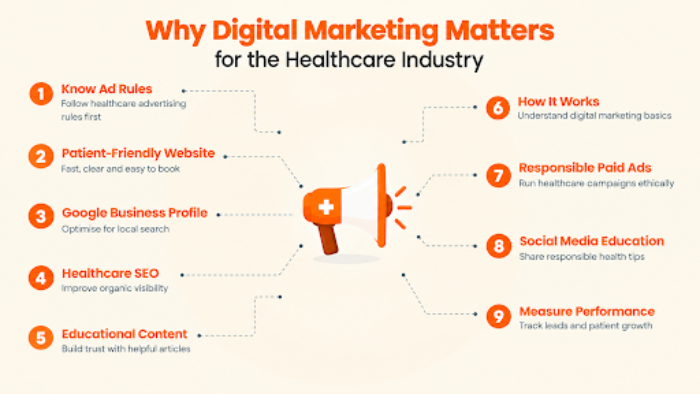
Step 1: Understand Healthcare Advertising Rules Before Starting
Before launching a healthcare marketing campaign, clinics should determine which professional and legal requirements apply to their organisation, registered medical practitioners, and proposed advertisements.
The NMC published guidelines titled “Guidelines on Ethical Advertising and Public Communication by Hospitals/Medical Institutions and Registered Medical Practitioners” on 6 October 2026. Clinics should review the official notification and its applicable scope before implementing marketing activities.
Official reference: https://nmc.org.in/whats-new?type=news
Step 2: Build a Patient-Friendly Website
Your website is an important source of information for people researching your clinic. It should answer essential questions clearly and make it straightforward to contact the appropriate team.
-
Create Dedicated Healthcare Service Pages
Each major service should have a relevant page containing accurate information about the service, the consultation process, and how to make an inquiry.
For example, a multispecialty clinic might create separate pages for:
- General physician consultations
- Dermatology services
- Dental consultations
- Gynaecology services
- Diagnostic testing
- Preventive health check-ups
Avoid publishing thin, repetitive pages that exist only to target different keywords. Each page should provide useful information about the specific service.
-
Make Contact and Appointment Information Easy to Find
Include the clinic's correct telephone number, address, opening hours, and available appointment options.
An appointment enquiry form should collect only the information necessary to respond to the request. Avoid asking visitors to submit detailed medical histories through an unsecured form. Where appropriate, provide a clear explanation of how submitted information will be handled and who can access it.
-
Improve Mobile Usability and Page Speed
Check whether visitors can read service descriptions, find contact details, and submit enquiries easily on mobile devices. Reduce unnecessary page elements, optimize images, fix broken links, and test important pages on different screen sizes to improve user experience, support SEO, and rank higher on Google.
A well-designed website supports usability and can help visitors move from discovering a service to contacting the clinic.
Step 3: Optimise Your Google Business Profile for Local Search
Local search is an important part of healthcare digital marketing because many people look for providers within a convenient distance. A complete Google Business Profile can help eligible clinics appear in relevant Google Search and Maps results.
Follow these steps:
- Claim and verify the clinic's profile.
- Use the accurate business name and the most relevant categories.
- Keep the address, phone number, opening hours, and website correct.
- Update holiday hours and temporary changes.
- Add genuine photographs of the clinic and its facilities while protecting patient privacy.
- Review profile information regularly for accuracy.
- Respond to public feedback without revealing confidential information.
How Should Clinics Handle Google Reviews?
Reviews can help people understand other customers' experiences, but they must be handled responsibly. Clinics should not create fake reviews, purchase favourable ratings, offer rewards for positive reviews, or disclose a reviewer's medical details in a public response.
A professional response to a complaint could say:
“We take feedback seriously and aim to provide a professional experience. Please contact our official clinic channel so the appropriate team can review your concern.”
Step 4: Use Healthcare SEO and AI SEO to Improve Organic Visibility
Search engine optimization helps a clinic's website become more discoverable for relevant healthcare searches. A sustainable healthcare SEO strategy combines useful content, accurate service information, local relevance, technical quality, and trustworthy medical information. AI SEO further focuses on making healthcare content easier for AI-powered search experiences to understand and potentially reference in generated answers.
1 - Research Keywords Based on Patient Intent
Start by identifying the services your clinic offers and the questions prospective patients are likely to search for.
Keyword categories may include:
- Clinic and specialist searches
- Healthcare service searches combined with a location
- Consultation and appointment-related queries
- Educational questions about medical conditions and treatments
- General preventive healthcare information
Use relevant terms naturally in titles, headings, page copy, and internal links. Address common patient questions clearly to help both traditional search engines and AI-powered search systems understand your content.
2 - Improve On-Page SEO
Review the following elements for each important service page:
- A unique, descriptive SEO title
- A clear H1 heading
- Relevant subheadings
- Accurate and helpful page content
- Descriptive image alt text
- A useful meta description
- Relevant internal links
- An appropriate canonical URL
Use clear headings, concise explanations, and relevant FAQs to make healthcare information easier to understand and potentially surface in AI-generated answers.
3 - Strengthen Technical SEO
Ensure that important pages can be crawled and indexed. Review mobile usability, broken links, page loading performance, sitemap inclusion, and indexability. Use structured data only when it accurately represents the clinic and follows applicable search engine guidelines. Maintain medically accurate content and demonstrate professional expertise to support trust across traditional and AI-powered search experiences.
SEO and AI SEO cannot guarantee specific rankings or AI citations, but a technically sound website with reliable, helpful content provides a stronger foundation for online visibility.
Step 5: Publish Educational Healthcare Content
Educational content can help clinics answer patient questions before a consultation. It should be accurate, clear, and reviewed by qualified professionals when discussing clinical matters.
For example, a dental clinic could explain routine dental examinations, while a dermatology clinic might cover when persistent skin symptoms need professional evaluation.
A useful healthcare blog should:
- Answer one clearly defined question.
- Use reliable medical references.
- Explain technical terms in plain language.
- Avoid unsupported statistics and treatment guarantees.
- Include relevant links to service pages.
- Identify qualified authors or medical reviewers.
- Update content when medical guidance changes.
Use AEO (Answer Engine Optimization): Structure content around common patient questions, use clear headings and concise answers, and add relevant FAQs. This helps search engines and AI-powered answer engines understand your content and potentially surface it in direct answers.
Do not diagnose readers through general blog content or suggest that everyone experiencing a particular symptom needs the same treatment.
Step 6: Understand How Digital Marketing Works for the Healthcare Industry
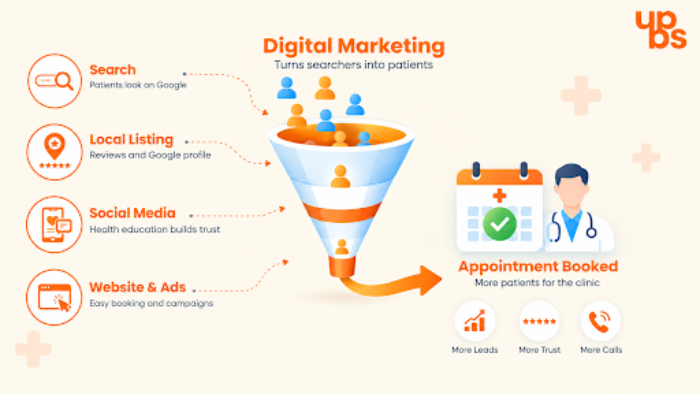
Understanding how digital marketing works for the healthcare industry requires looking at the complete patient journey rather than evaluating individual marketing channels in isolation.
Stage 1: Discovery
A person searches for a healthcare service or general medical information. Relevant search results, local listings, and permitted advertisements can help them discover the clinic.
Stage 2: Evaluation
The person reviews the clinic's website, services, location, opening hours, and available information about healthcare professionals. Accurate and transparent information can help them understand whether the clinic is relevant to their needs.
Stage 3: Enquiry
The person calls the clinic, submits an enquiry, or uses an available appointment process. Clear contact information and a simple website experience can reduce unnecessary friction.
Stage 4: Appointment and Communication
The clinic responds to the enquiry and handles scheduling through appropriate channels. Any follow-up messages should respect patient preferences, confidentiality, and applicable consent requirements.
Stage 5: Measurement and Improvement
The clinic reviews aggregated marketing data to understand which pages and activities contribute to enquiries. This information can guide improvements to the website, content, and permitted campaigns.
Digital marketing supports the discovery and communication process, but it does not replace clinical quality or guarantee that a visitor will become a patient.
Step 7: Run Paid Healthcare Campaigns Responsibly
Paid advertising can increase visibility for eligible healthcare services, but campaigns must be reviewed carefully before launch.
A responsible process includes:
- Confirming that the service and advertiser are eligible.
- Checking current platform policies and applicable professional restrictions.
- Writing factual, non-misleading advertisement copy.
- Using relevant landing pages with accurate service information.
- Avoiding prohibited targeting based on sensitive health information.
- Reviewing conversion tracking and data collection practices.
- Setting a budget appropriate to the clinic's resources.
- Evaluating enquiries and expenditure instead of relying on clicks alone.
Google and Meta apply their own rules to healthcare-related advertisements. Approval from an advertising platform does not establish legal or professional compliance.
Step 8: Use Social Media for Responsible Health Education
Social media can help clinics communicate general health information, explain available services, and share practical clinic updates.
Suitable content may include:
- General preventive healthcare guidance
- Explanations of consultation procedures
- Public health awareness information
- Clinic opening hours and service updates
- General preparation tips for appointments
- Educational videos reviewed by qualified professionals
Before publishing patient photographs, clinical stories, or treatment-related content, review applicable consent, privacy, professional, and advertising requirements.
Step 9: Measure Healthcare Marketing Performance
A clinic should understand whether its marketing efforts are improving visibility and generating relevant enquiries.
Useful metrics include:
|
Metric |
What it helps measure |
|
Search impressions |
How often the website appears in search results |
|
Organic clicks |
Visits from unpaid search results |
|
Relevant service-page visits |
Interest in particular clinic services |
|
Appointment enquiries |
Requests for more information or bookings |
|
Enquiry conversion rate |
The proportion of relevant visits that lead to enquiries |
|
Advertising expenditure |
The amount spent on eligible campaigns |
|
Cost per enquiry |
Marketing spend relative to enquiries generated |
A click is not the same as an appointment, and an appointment enquiry is not the same as a completed consultation. Define reporting metrics clearly, review trends over time, and protect patient confidentiality when connecting marketing data with operational records.
How UPBS Technology Can Help Healthcare Businesses Grow Online
Choosing the right healthcare digital marketing agency is essential for clinics and hospitals looking to improve online visibility, reach relevant audiences, and generate more appointment enquiries. Our approach focuses on understanding your services, target audience, competitors, and business goals to develop a strategy tailored to your healthcare practice. We can help you:
- Improve Google Visibility: Optimize website content, service pages, and relevant keywords to help your clinic rank higher on Google.
- Strengthen Local SEO: Optimize your Google Business Profile and local search presence so patients can discover your practice more easily.
- Optimize Your Website: Improve website structure, mobile usability, page performance, and contact forms to make it easier for visitors to explore services and submit enquiries.
- Create Relevant Content: Develop informative, search-focused content that answers patients' common questions while prioritizing medical accuracy and trust.
- Generate Relevant Enquiries: Improve conversion paths through clear calls to action, accessible contact details, and appointment enquiry options.
- Track Marketing Performance: Monitor organic traffic, search visibility, website engagement, and available enquiry data to identify opportunities for improvement.
When evaluating healthcare digital marketing services, look for a partner that prioritizes transparency, measurable progress, and responsible marketing practices. UPBS Technology can help your healthcare business build a stronger online presence with a strategy aligned with your goals, while healthcare-specific content, advertising, and privacy requirements should be reviewed as applicable.
Frequently Asked Questions
- What is healthcare digital marketing?
Healthcare digital marketing involves using online channels such as search engines, clinic websites, local listings, educational content, and eligible advertising to help people discover healthcare services and contact providers.
- Is digital marketing legal for clinics in India?
Healthcare marketing activities must comply with applicable professional conduct rules, advertising and consumer-protection laws, privacy requirements, and platform policies. The permitted activities may differ depending on the provider and the type of promotion. Clinics should review the latest applicable rules before launching campaigns.
- Which healthcare digital marketing services should clinics start with?
Many clinics can begin by improving their website, local search information, important service pages, and educational content. Additional services should be selected according to the clinic's needs and the applicable advertising restrictions.
- Can clinics use Google Ads to attract patients?
Some healthcare advertising is permitted, while particular services, claims, targeting methods, and landing pages may be restricted. Clinics should verify the current platform policies and professional requirements before running advertisements.