Both platforms look right on paper, but only one will return more money for your specific business. Many companies choose a platform based on the upfront quote and discover two years later that maintenance, plugin fees, or growth limits changed the math completely.
In this guide, we compare WordPress vs custom websites across cost, SEO, speed, security, and scalability. You will also learn how to calculate website ROI yourself, so the decision rests on numbers rather than opinions. If budget is your first question, start with our breakdown of website development costs.
What Is a WordPress Website?
A WordPress website is built on the world’s most widely used content management system (CMS), which lets businesses launch and manage a site without coding everything from scratch. It runs on themes and plugins, which is why it is fast to build and easy to update.
Typical advantages include:
- Lower initial investment
- Launch in a few weeks
- Easy content publishing for non-technical teams
- Thousands of plugins for added features
- A large global developer community
WordPress powers a very large share of the web (W3Techs reports well over 40% of all websites, so check the latest figure before publishing). For a small business, a well-built WordPress website is often the quickest route to a professional online presence.
What Is a Custom Website?
A custom website is coded specifically for your business, without pre-built themes or plugin dependency. Every page, workflow, and feature is planned around your goals, which gives you full control over performance, security, and future growth.
Custom builds make sense when you need logins and dashboards, booking engines, complex integrations, or automation that plugins cannot handle cleanly. For example, connecting your website to a custom CRM lets leads flow straight into your sales pipeline with no manual copying.
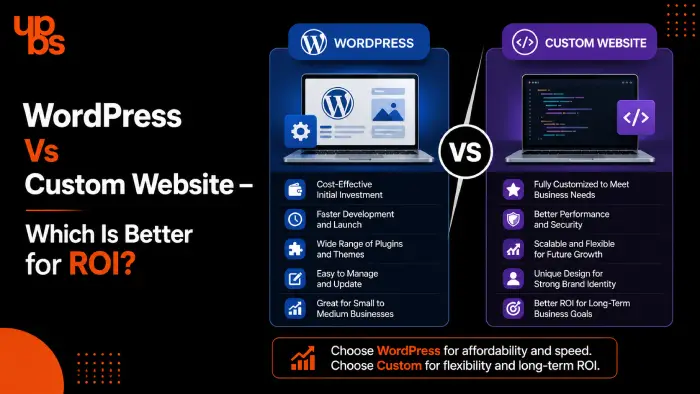
WordPress vs Custom Website: Quick Comparison
WordPress is cheaper and faster to launch, while a custom website offers deeper flexibility, tighter control, and easier scaling. Neither is automatically better; the right answer depends on how complex your needs are today and how fast you expect to grow.
|
Factor |
WordPress Website |
Custom Website |
|
Upfront cost |
Lower |
Higher |
|
Build time |
2-6 weeks |
2-6 months |
|
Customisation |
Moderate, plugin-based |
Unlimited |
|
Scalability |
Good for standard sites |
Built for growth |
|
Speed |
Depends on theme and plugins |
Optimised by design |
|
Security |
Depends on updates and plugins |
Custom-built protection |
|
SEO |
Strong, plugin-led |
Strong, code-led |
|
Maintenance |
Frequent plugin updates |
Planned support contract |
In short, WordPress wins on speed and budget. Custom wins on control. Our guide to website development explains each build stage if you want more detail.
Development Cost: What You Pay Upfront
WordPress usually costs less to build because developers use proven themes, plugins, and frameworks. A custom website costs more because it includes business analysis, UI/UX design, frontend and backend coding, database planning, testing, and deployment. At UPBS Technology, website development starts from ₹50,000, and the final price depends on your scope.
Here is what drives the price in either case:
- Number of pages and templates
- Features and integrations required
- Design complexity
- eCommerce or user-account functionality
- Content migration and SEO setup
For a detailed breakdown by project type, see our pricing guides and ask for a requirement-based estimate.
Hidden and Ongoing Costs Most Businesses Miss
The upfront quote is only part of the cost. Over three to five years, ongoing expenses often decide which platform is truly cheaper, and these are the items businesses forget to budget for.
For WordPress, expect premium plugin licences, better hosting as traffic grows, regular security patches, and fixes when plugin updates conflict with each other.
For custom websites, expect a maintenance or support contract, server and cloud costs, and development charges for each new feature.
Neither list is a reason to avoid a platform. It simply means total cost matters more than the first invoice. An experienced team offering website development services in Noida can map these costs before you commit.
Which Is Better for SEO?
Both platforms can rank on page one. WordPress makes SEO easy through plugins and simple publishing, while a custom website gives developers deeper technical control. The difference is control, not capability.
WordPress SEO strengths:
- SEO plugins for titles, meta descriptions, and sitemaps
- Easy blog publishing and internal linking
- Schema support and mobile-friendly themes
Custom website SEO strengths:
- Lightweight, clean code and faster loading
- Better control over Core Web Vitals
- Custom URL structure and crawl management
WordPress can slow down if overloaded with plugins, and a custom site only ranks if the build follows SEO best practice. Whichever route you take, pairing it with professional SEO services matters more than the platform itself.
Speed, Performance and Security
A fast, secure website protects both rankings and revenue. Slow pages raise bounce rates, and Google uses page experience signals, so performance directly affects ROI. Studies from Google and Deloitte have linked even small speed gains to higher conversions, so confirm the latest numbers before citing.
WordPress can perform very well with quality hosting, caching, optimised images, and a limited plugin set. Security depends on keeping core, themes, and plugins updated, since vulnerabilities most often come from outdated plugins (a pattern reported by security firms such as Patchstack and Sucuri).
Custom websites load only the code your business needs, which reduces bloat and the attack surface. Security is designed into the architecture, with strong backend development practices such as role-based access, input validation, and secure data handling.
Scalability: When Does WordPress Hit Its Limits?
WordPress scales comfortably for blogs, service businesses, and small stores. It starts to strain when you need heavy integrations, complex user roles, multi-vendor marketplaces, or high-traffic custom workflows, because each addition usually means another plugin.
Signs you may be outgrowing WordPress:
- Pages slow down as plugins pile up
- Developers say a feature “can’t be done” without workarounds
- Maintenance takes more time every month
- You need deep ERP, CRM, or payment integrations
A custom build avoids these ceilings because new modules are added to a planned architecture. Businesses with long-term growth plans often discuss this with a custom software development company early.
eCommerce: WooCommerce or Custom?
WordPress with WooCommerce suits small to mid-sized stores with standard products and checkout flows. Custom ecommerce suits businesses with complex inventory, tiered pricing, subscriptions, multiple vendors, or very high transaction volume.
The deciding question is simple. If your store’s logic fits a plugin, WooCommerce is cost-efficient. If you keep bending the plugin to fit your process, custom saves money over time. Smooth shopping also depends on a polished storefront, which is where strong frontend development helps conversions.
How to Calculate Website ROI (WordPress vs Custom)
Website ROI is the profit your site generates compared with what it costs you. The basic formula is: ROI (%) = (Revenue from website − Total website cost) ÷ Total website cost × 100. Always use the total cost over three years, not just the build price.
Follow these steps to run the numbers for your own business:
- Add up total cost: build cost, hosting, plugin or software licences, security, maintenance, and updates over three years.
- Estimate website revenue: monthly leads × lead-to-customer conversion rate × average order or deal value.
- Apply the formula separately for WordPress and for a custom build.
- Compare payback time: how many months until revenue covers the total cost.
The result often surprises people. A lower-cost WordPress site can deliver a higher percentage ROI when your needs are standard. A custom website pays off when its extra speed, features, or capacity produce extra leads and sales that a plugin-based site could not. In short, custom wins only when the added capability turns into added revenue.
Track leads, conversion rate, and cost per lead from day one, and a good digital marketing team can help you measure these accurately.
Which Option Offers Better ROI? (Decision Guide)
WordPress usually gives faster ROI for standard business sites, while a custom website gives stronger long-term ROI for complex, high-growth businesses. Your stage of growth matters more than the platform’s reputation.
Choose WordPress if you:
- Have a limited budget or need to launch quickly
- Publish blogs and update content often
- Run a local, service, or small business
- Need standard features without special workflows
- Want to validate your idea before bigger investment
Choose a custom website if you:
- Need unique functionality or deep integrations
- Expect rapid growth or high traffic
- Handle sensitive data and need tighter security
- Are spending heavily on plugin workarounds
- Plan to build a platform, portal, or marketplace
There is also a middle path: start on a well-built WordPress site, then move to custom or a headless setup when growth demands it. Seeing how others handled this is useful, so browse our case studies for real examples.
Why Choose UPBS Technology?
UPBS Technology builds websites designed to generate leads and deliver measurable ROI, whether you need a WordPress site or a fully custom solution. Our designers, developers, and SEO specialists work as one team, so your website is fast, secure, and built to convert.
Our website services include:
- Custom website development and design
- WordPress development and design
- Custom ecommerce development
- Website redesign and UI/UX design
- Maintenance and SEO-friendly development
We recommend the platform that fits your goals, not the one that earns us the bigger project. See examples of our work in our portfolio.
Frequently Asked Questions
- Is WordPress or a custom website better for ROI?
WordPress often delivers faster ROI for small and standard business sites because it costs less to build. A custom website delivers stronger long-term ROI when you need advanced features, high traffic, or deep integrations that directly produce more leads and revenue. - How much more does a custom website cost than WordPress?
A custom website typically costs several times more upfront than WordPress because it involves design, coding, and testing from scratch. The exact gap depends on features and integrations, so request a scoped estimate and compare total three-year cost instead of build price alone. - Is WordPress good for SEO compared to a custom website?
Yes. WordPress is very SEO-friendly through plugins, clean publishing, and schema support. A custom website offers deeper technical control over speed and architecture. Both can rank well when built correctly, so execution and content quality matter more than the platform. - When should I switch from WordPress to a custom website?
Consider switching when plugins slow your site, new features need constant workarounds, security fixes take too much time, or growth demands integrations WordPress handles poorly. If maintenance costs keep rising, a custom rebuild may deliver better long-term value. - Is a custom website more secure than WordPress?
A custom website can be more secure because it avoids third-party plugin vulnerabilities and uses tailored protection. However, security depends on build quality and upkeep. A well-maintained WordPress site is safer than a poorly coded custom one. - Can I start with WordPress and move to custom later?
Yes, many businesses launch on WordPress to validate their idea and budget, then migrate to a custom build as needs grow. Plan SEO, URL structure, and content migration carefully so rankings and traffic are preserved during the switch.
Conclusion
There is no universal winner in the WordPress vs custom website debate. WordPress delivers affordability, speed, and easy content management, while a custom website offers control, security, and scalability for complex or fast-growing businesses. The better ROI comes from matching the platform to your goals and measuring results over three years.
Not sure which fits your business? Get a free website consultation with UPBS Technology and get a clear recommendation based on your budget and growth plans.