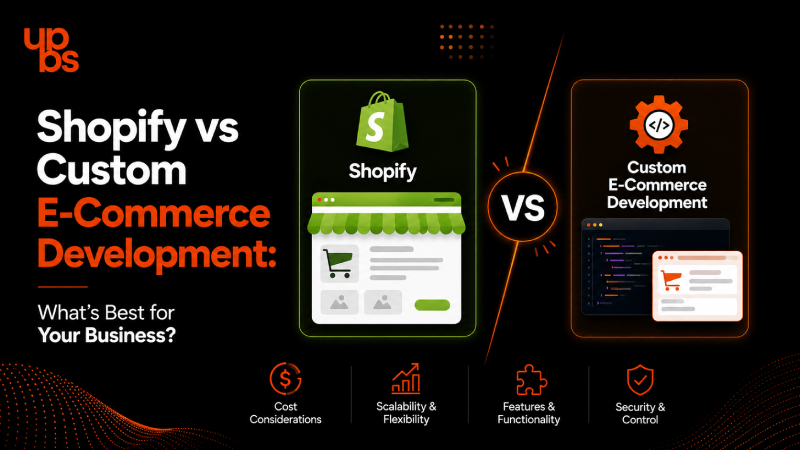
runway and a bigger initial budget.Every growing retail business eventually hits the same crossroads: should you build your online store on Shopify, or invest in custom e-commerce development? It's one of the most common questions we hear from founders and business owners planning their next stage of growth and honestly, there's no single right answer for everyone.
Both paths are valid. The right choice depends on your business stage, your budget, your product complexity, and where you're planning to be in two or three years, not on which option sounds more "modern" or impressive. As an experienced ecommerce development company, we've worked with businesses on both ends of this decision, and this guide is meant to give you a clear, unbiased framework to figure out what actually fits your business, not a sales pitch for one platform over the other.
By the end of this post, you'll understand exactly what each approach offers, where each one falls short, and how to make a decision you won't regret six months from now.
What Is Shopify E-Commerce Development?
Shopify is a hosted e-commerce platform that lets you set up an online store using pre-built themes, a drag-and-drop editor, and a large marketplace of apps for everything from inventory to email marketing. With Shopify web development, a developer customizes the theme, adds the apps your business needs, and configures payments, shipping, and checkout all on top of Shopify's existing infrastructure.
Shopify's scale is part of why it remains the default starting point for so many brands: the platform now holds roughly 30% of the US e-commerce platform market and about 10.6% of the market globally, with close to 4.82 million active stores running on it worldwide as of early 2026.
What Shopify is genuinely good for:
- Speed to launch — a well-scoped Shopify store can go live in a matter of weeks, not months
- Low ongoing maintenance — hosting, security, and uptime are handled by Shopify itself
- Built-in payments and hosting — no need to separately manage servers, SSL, or payment gateway infrastructure
- A mature app ecosystem — most common e-commerce needs (reviews, upsells, subscriptions) already have a plug-and-play solution
Typical cost and timeline: Shopify's own published plans start around $39 a month and scale up to roughly $2,300+ a month for Shopify Plus, before factoring in apps and developer/customization time. A standard store built with a customized theme and a handful of apps generally takes 3–6 weeks. Costs rise as you add more customization, third-party subscriptions, and design work but it remains the faster, lower-upfront-cost route for most businesses starting out.
What Is Custom E-Commerce Development?
Custom e-commerce development means building your store from the ground up or on a highly flexible framework designed specifically around how your business actually operates, rather than fitting your business into a platform's existing structure. In practice, this is custom software development applied to retail which is why working with an experienced ecommerce app development company makes the biggest difference, since custom builds require deeper technical planning from day one.
What custom development is genuinely good for:
- Unique business logic — tiered pricing, complex product configurators, B2B workflows, or subscription models that don't map cleanly onto standard platforms
- Deep integrations — connecting your store directly with CRM, ERP, inventory, or logistics systems, handled through solid backend development rather than relying on third-party app workarounds
- Long-term scalability — built to handle growing traffic, catalog size, and business complexity without hitting platform ceilings
- Full ownership — your store isn't dependent on a third-party platform's pricing changes, feature limitations, or policies
- Tailored design and usability — since nothing is templated, your UI/UX design can be built entirely around how your customers actually shop
Typical cost and timeline, honestly: Industry benchmarks for 2026 put custom e-commerce development in the $80,000–$500,000 range, with most mid-market builds landing between $120,000 and $250,000, and a realistic timeline of three to six months at minimum. This isn't a downside to hide it's simply the tradeoff for flexibility and long-term control. Businesses that choose custom development should go in expecting a longer
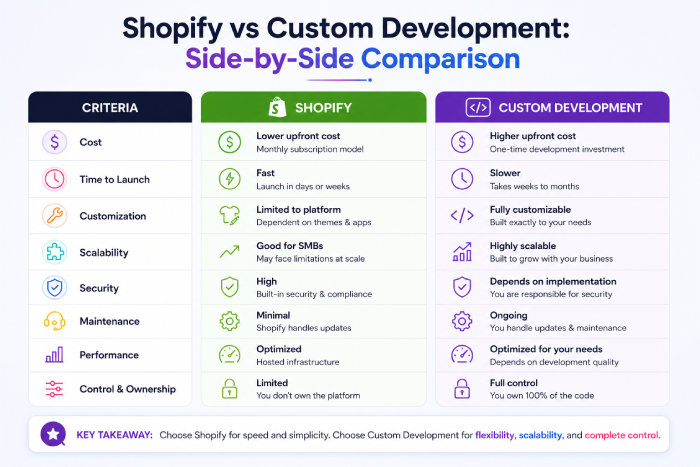
Shopify vs Custom Development: Side-by-Side Comparison
Here's a quick, at-a-glance look at how the two approaches compare across the factors that matter most: cost, speed, flexibility, and long-term scalability.
|
Factor |
Shopify |
Custom Development |
|
Setup speed |
Fast (weeks) |
Slower (months) |
|
Upfront cost |
Lower |
Higher |
|
Long-term/scaling cost |
Can rise with app subscriptions & transaction fees |
Higher initial cost, often lower long-term marginal cost |
|
Design & UX flexibility |
Good within theme/app limits |
Unlimited — built around your exact needs |
|
Integration capability (CRM, ERP, custom logic) |
Possible via apps, but often limited or workaround-based |
Deep, native integrations possible |
|
Ownership & platform dependency |
You're dependent on Shopify's platform and policies |
Full ownership of your codebase and infrastructure |
|
Maintenance requirements |
Low — Shopify handles hosting/security |
Higher — requires ongoing technical maintenance |
|
SEO control |
Good, but some technical limitations |
Full control over site architecture and technical SEO |
|
Best suited for |
New brands, standard catalogs, lean teams |
Complex catalogs, B2B models, high-growth or high-traffic brands |
Shopify optimizes for speed and simplicity, while custom development optimizes for control and scalability. Either way, the platform is only half the story without a strong SEO strategy behind it, even the best-built store struggles to get found.
Which Businesses Are Best Suited for Shopify Development?
For a large number of businesses, Shopify isn't a compromise, it's genuinely the smarter decision. It works especially well for D2C fashion and apparel brands, beauty and cosmetics stores, home decor and lifestyle brands, food and beverage startups, and single-category retail businesses just getting started online. Shopify is the right fit if:
- You're a new brand validating product-market fit. You need to get to market fast and see what sells before investing heavily in infrastructure.
- Your budget or timeline is limited. You want a professional, functional store without a large upfront investment. Worth keeping in mind: most new stores, regardless of platform, should plan for a 6–12 month runway before turning profitable so keeping upfront costs low gives you more room to reach that point.
- Your catalog and checkout needs are fairly standard. Simple product variants, straightforward pricing, and typical checkout flows.
- You don't have in-house technical resources. Shopify's ecosystem is built to be manageable without a dedicated development team on standby.
Which Businesses Are Best Suited for Custom E-Commerce Development?
Custom development starts to make more sense once your business outgrows what a templated platform can comfortably handle. It's typically the better fit for B2B wholesalers and distributors, manufacturing and industrial suppliers, businesses with subscription or membership models, multi-vendor marketplaces, and high-volume enterprise retailers. Custom development is the right fit if:
- You have complex product catalogs, B2B pricing, or subscription models that Shopify's standard structure struggles to support cleanly.
- You need deep integration with a CRM, ERP, or inventory system to keep operations, sales, and fulfillment connected in real time. This is where custom CRM services built specifically around your store's workflow make the biggest difference.
- You're a high-traffic brand hitting Shopify's flexibility or cost ceiling as a rough benchmark, once annual revenue moves past roughly $5 million, the total cost of a custom build tends to compare favorably against ongoing platform and transaction fees.
- You want full ownership and long-term scalability, without being tied to a third-party platform's roadmap or pricing model.
Common Mistakes Businesses Make When Choosing
We've seen founders on both sides of this decision run into avoidable problems:
- Choosing Shopify purely because it's "easy," without planning for scale. This often means an expensive re-platforming project down the line once the business outgrows it.
- Going custom too early, before validating the business model. Investing heavily in a custom build before proving demand is one of the costliest early-stage mistakes.
- Ignoring the long-term cost of Shopify apps and subscriptions. Individually small, these add up significantly over a year or more of operation.
- Underestimating custom development timelines. Businesses that treat a custom build like a quick project often end up frustrated by realistic engineering timelines.
- Building the store first and thinking about growth later. A great platform choice still needs a digital marketing plan behind it otherwise you've built a store with no one to visit it.
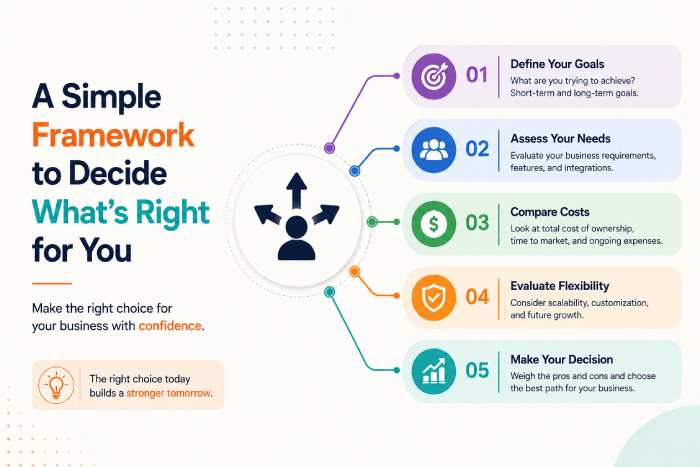
A Simple Framework to Decide What's Right for You
Before deciding, ask yourself these questions honestly:
- How complex is my product catalog and pricing structure? Simple = Shopify leans favorable. Complex/tiered/B2B = custom leans favorable.
- Where do I expect my business to be in 2–3 years? If you're planning significant scale, factor that into today's decision.
- What's my realistic budget — not just for launch, but for the next 12 months? Include app costs, transaction fees, or development/maintenance costs.
- How much do I need my store to talk to other systems (CRM, inventory, logistics)? Heavy integration needs to favor custom.
- What's my actual timeline? If you need to launch in weeks, not months, that alone may decide it for you.
This isn't about which platform is "better" in the abstract, it's about which one matches your business today, with room to grow into tomorrow.
What If You Need Both? Finding the Right Balance
For many growing businesses, the real answer isn't strictly Shopify or custom, it's a hybrid approach. Some businesses launch on Shopify to validate demand quickly, then migrate specific high-complexity areas (like a B2B ordering portal or a custom pricing engine) to custom-built systems while keeping the core storefront on Shopify. Others use Shopify as the front-end storefront while connecting it to a custom-built CRM or inventory system behind the scenes, getting the speed of Shopify with the operational depth of custom development where it matters most.
The key is not treating this as an all-or-nothing decision. The right balance depends on which parts of your business genuinely need flexibility and which parts are well served by a proven, standard platform.
How UPBS Technology Can Help You For E-Commerce Development
Whichever type of business you run, UPBS Technology can help you figure out and build the right e-commerce solution, without pushing you toward one option by default.
If your business fits the Shopify profile, our team handles the theme customization, app integrations, payment and checkout setup, and design work needed to get a fast, professional store live as one of the best Shopify development company options for brands that want speed without compromising on quality.
If your business fits the custom development profile, we build your store from the ground up covering everything from backend architecture and CRM/ERP integrations to UI/UX design as an experienced ecommerce development company and ecommerce app development company, so the final platform is built entirely around how your business actually operates.
And if you're not sure which category you fall into, that's exactly where we start with a conversation about your catalog, your budget, your growth plans, and your existing systems, so the recommendation is based on your business, not a one-size-fits-all pitch. We've helped brands launch fast on Shopify, migrate to custom platforms as they scale, and run hybrid setups that use both whatever gets your business the right result.
Conclusion
There's no universally "better" platform between Shopify and custom e-commerce development, only what genuinely fits your business today and where you're headed next. Shopify offers speed, simplicity, and lower upfront cost. Custom development offers flexibility, deep integration, and long-term ownership. The right decision comes down to your catalog complexity, your growth plans, your budget, and your timeline not trends or assumptions.
Not sure which path fits your business? Get a free e-commerce consultation with UPBS Technology and we'll help you figure out the right approach for where your business is today and where it's going next.